Inconsistency is hypocrisy in disguise - Part 4 of 6, a Response to Grant Genereux's "Are Supplements Ruining the Low Vitamin A Diet?"
Originally posted on Substack on September 19, 2025.
Jump To: Part 1, Part 2, Part 3, Part 4, Part 5, Part 6...as responses to Grant’s article here.
Grant’s Misplaced Frustrations

We return to Grant’s email inbox to find a Love Your Liver program member reporting they were recovering from their ulcerative colitis:
Bob’s case
A few months ago, I received an email inquiry from a young man (age 30ish) who had been diagnosed with Ulcerative colitis. He’s on medications and said his overall health is just getting worse and worse. Bob (not his real name) came across this YT video from another young man who reported making very good progress in recovering from his own Ulcerative colitis using a low vA diet.
Let’s be clear here. This young man states within the first 20 seconds of the video that he was was doing my Love Your Liver program. Grant fails to to mention that fact here. Interesting. The pattern of Grant diligently avoiding saying my name or referencing my work shows up again.
Anyway, Bob started reading more about the low vA diet and came across a report of a child who’d been harmed while on the diet. Bob stated: “I’m already really sick, I can’t risk getting sicker” and was looking for assurance that he wouldn’t. Of course, I can’t give such assurances.
This is a truth in health and medicine. There are no guarantees. Ever.
Very sadly, Bob decided that the low vA diet was not for him and was going to stick with conventional treatments (which often ends with the removal of the colon). I say very sadly because there are other case reports in the carnivore diet crowd where people have recovered from Crohn’s / colitis, so I think the probability of the low vA diet working for Bob was quite high.
People read things on the internet every day and make good and bad decisions. People lie every day on the internet too.
Is it possible that this person read Grant’s descriptions of “detox setbacks” as part of their information-collecting process? They were already on his website if they emailed him and would have been expected to see things of this nature if they were researching his approach.
Is it possible that the thought of the “prison diet” (red meat, beans, and rice) every day for the rest of his life swayed his decision? Grant doesn’t provide any other dietary options than that. Very, very few people are willing to eat only 3 foods for the rest of their life!
We will never know.
A few years ago, someone reported that there was a parent who had a child on a low vA diet and they suffered a setback in their health. I think that report was on my forum, but I’m not sure where I had read it.
A few years ago, somewhere on the internet, someone secondhand reported that a parent reported some sort of “setback” in their child. The veracity of this report was not verified. My guess is that this case study won’t ever be published anywhere.
On that note, what exactly is/was the parent’s responsibility in this situation?
However, there was also some comment (either on my forum or by email) that they may have been taking lactoferrin too. I haven’t tried verifying that report, but I think it is possible as I’ve heard that there are hundreds of people taking lactoferrin.
“...may have been…”
“...haven’t tried verifying…”
“…I think it is possible…”
A third-party comment—on a third-party report—from a forgotten location—gives a secondhand report that there might have been lactoferrin involved. Not sure this would hold up as evidence of anything, anywhere.
Either way, I think this might be the case report that Bob was referring to. If that’s true (and I don’t know that it is), then yes some of these god damn supplements are going to ruin the reputation of the low vA diet.
“...I think this might be…”
“If that’s true (and I don’t know that it is)...”
“...god damn supplements…”
Seems like an extremely weak evidence trail to end up with such a strong emotional reaction, does it not?
Does Grant believe that people are entirely unable to separate the effects of their daily nutrition versus the effects of supplements?
What have we actually ended up with here then? A confirmed testimonial to my work helping ulcerative colitis, and not much else.
Grant’s Non-Existent Calcium Deficiency
Calcium deficiency and bad advice
Back in 2021 in my Seven-Year Update blog post I highlighted the concern about the low calcium intake on the low vA diet. To address that concern for myself I started drinking mineral water. Moreover, up until 2024 I had been drinking spring water (and even our tap water) with a calcium content of about 300 mg/L. So, I was getting about 500 mg of calcium per day just from water. Meaning that water was my primary source of calcium and other minerals including magnesium and potassium. Of course, I was also getting some calcium etc. from beans too. I seem to have done OK with that combined amount.
I see that Grant “highlighted the concern” about calcium. He addressed that concern only for himself at the time by adding mineral water.
Did he lead others to do the same, or give any recommendations? No, he did not.
Did he do any type of blood testing to investigate his calcium status? No, he did not.
After 7 years on the diet, was Grant showing any bone loss from his low-calcium diet? No, he wasn’t:
“Thus, I recently had a bone density scan (DEXA) performed. The scan results were surprisingly very good. My bone density is perfectly normal for my age, and I was told that I have absolutely nothing to worry about. I think this is another big win for a low vA diet. Apparently, that recommended 1000 mg / day is not needed if vA is not silently picking away at our bones. And, we probably don’t want a bunch of needless extra calcium in our diet that might otherwise contribute to clogging our arteries etc.”
Grant’s bone density was “very good” and “perfectly normal for [his] age” after SEVEN years. If anything, his DEXA scan showed NO evidence of systemic calcium deficiency in his system at all.
To review Grant’s demonstrated testing results then:
-
Grant demonstrated “severe deficiency” of serum retinol (aka “blood vitamin A”)—shown via labwork in year 4, year 5, and year 10—without any supposed “vitamin” A deficiency symptoms over a 10-year period of low vA nutrition.
-
Grant’s DEXA bone scan showed NO bone loss, and he never described any typical calcium deficiency symptoms, over a 7-year period of a so-called low calcium diet.
As a reminder, Grant was (based on his reported symptoms and subsequent recovery), terribly “vitamin” A toxic 10 years ago. This should have degraded his bones considerably (according to both his quote above and the research), between his toxicity level and his age.
Yet, 7 YEARS into his low vA dieting, with a diet that was HALF of the RDA or LESS for calcium, his bone density was PERFECTLY NORMAL.
It can then be surmised then, that a low vA diet is likely able to REBUILD BONES damaged by “vitamin” A toxicity even while on a supposedly “low calcium” diet. I have had multiple people report improved DEXA bone scans to me saying that this is exactly what happened.
Fortifying the Calcium Inconsistencies
What does the research have to say about low-calcium diets in large populations?
#1 - "Paradoxically, many lower- and middle-income countries with lower calcium intakes show lower rates of osteoporotic fracture as compared with high-income countries, though data are sparse.”
This seems to be in complete agreement with Grant’s experience. Low- and middle- income countries are known to consume less dairy (therefore less calcium and less “vitamin” A), and are likely consuming significant beans and grains. Two MAJOR similarities to general low vA approaches!
#2 - “If more than half of the world's population is calcium deficient, then why we do not observe its consequences often?“
#3 - “Although low calcium intake has been identified in many countries for several years, it has not been prioritized by most countries. This may be because low calcium intake is not viewed as being a life‐threatening condition in the overall population as compared with other key nutrients“
That final quote is from a paper about calcium fortification of foods (red flag alert!!!), which leads to my next point.
Grant made it clear in his books that he believes food fortification with “vitamin” A is always a bad thing, with nefarious intentions (first mentioned page 55). He believes that “vitamin” A deficiency doesn’t actually exist (I agree). He has long-term proven it with his bloodwork and lack of symptoms over 10 years of his “prison diet”.
Considering that Grant messed himself up with Canada’s fortified flour (covered in detail in the next part of this series), how does he feel about the government fortifying foods in general?
Thick sarcasm in that quote aside, he obviously is against food fortification in general. To stay consistent with his stance, if calcium (carbonate) is being used to fortify foods, then he should also take a stand against it.
If the powers-that-be are suggesting epidemic “calcium deficiency” problems exist that require food-fortification efforts…well, doesn’t this all sounds eerily similar to the “vitamin A deficiency” problem requiring food-fortification efforts!?!?
If they were similar in being unnecessary, with nefarious intentions behind them, we’d expect food fortification with calcium to come next, right?
Are foods being fortified with calcium? That would seem damning if true, wouldn’t it?
The UK requires mandatory fortification of wheat flours with calcium.
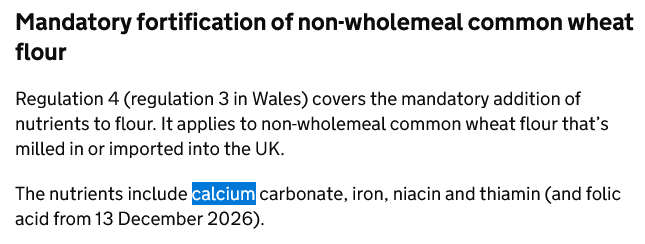
While there are no other mandatory food fortification rules for calcium, it’s definitely on the way.
“Benevolent” food and beverage corporations are now voluntarily fortifying their products with calcium to “make sure we get enough”. Here’s a list of food categories that some companies have fortified with calcium because they are “looking out for our own good”:
-
Dairy products (yes, really!)
-
“Also, when using low soluble calcium salts, sequestering agents with pH adjustment are added to prevent sedimentation. Also, stabilizers such as carrageenan and guar gum are added. This is a common practice when fortifying milk, milk‐based beverages, and products such as yogurt and cheese, to maintain calcium in suspension and to improve mouthfeel and appearance.”
-
-
Bottled waters
-
Plant based milks (soy-based, nut-based, seed-based, grain-based, etc.)
-
Juices (especially orange juice)
-
Breakfast cereals, breads, tortillas, crackers
-
Sports drinks
-
Nutrition bars
There are many people who “seem to have done OK” calcium-wise on even less calcium than Grant was getting over the years. I’m one of those people.
Some people might need more calcium than they were getting with their dietary choices, and this can happen with any nutrient. Biochemical individuality is a very real thing, and there are many factors involved, as Grant noted earlier.
I cover the nuances of calcium further in my livestream here:
Do people need some individualized amount of dietary calcium? Yes, of course!
Is getting an excess of calcium, especially through supplements, a known way to an early grave? Yes, absolutely. Grant knows this: ”…we probably don’t want a bunch of needless extra calcium in our diet that might otherwise contribute to clogging our arteries etc.”
Inconsistency is the enemy of credibility.
Grant & Tap Water
For most people in the health world, the evidence is clear that one cannot and should never trust the quality and purity of tap water. Let’s see how Grant feels about that.
Making a bad situation worse
We already know that a vA toxicity condition depletes the calcium in the bones. Very unfortunately there have been some folks strongly advising people to exclusively use reverse osmosis or distilled water. In the context of an already low calcium diet this is very bad advice because these two processes remove all the minerals from the water and result in the water being slightly acidic as well. Therefore, drinking these waters will force your body to pull even more calcium from the bones to maintain a proper pH level. So, this “expert” advice is pretty much a prescription for disaster. Of course, one could re-mineralize the water with supplements but why take on the risk of bone loss, added costs and why make it so complicated?
Grant seems to be a fan, or at least quite trusting, of the quality of water that comes out of the tap at his home and work. I do not share this opinion, and I have plenty of research to back up my position. Let’s talk about what can be commonly left in tap (& well) waters when it isn’t filtered well enough. Remember this saying, “buy a filter, or BE the filter”.
On Tap (Water) in Canada
What is in the tap water of our northern neighbor country, anyway?
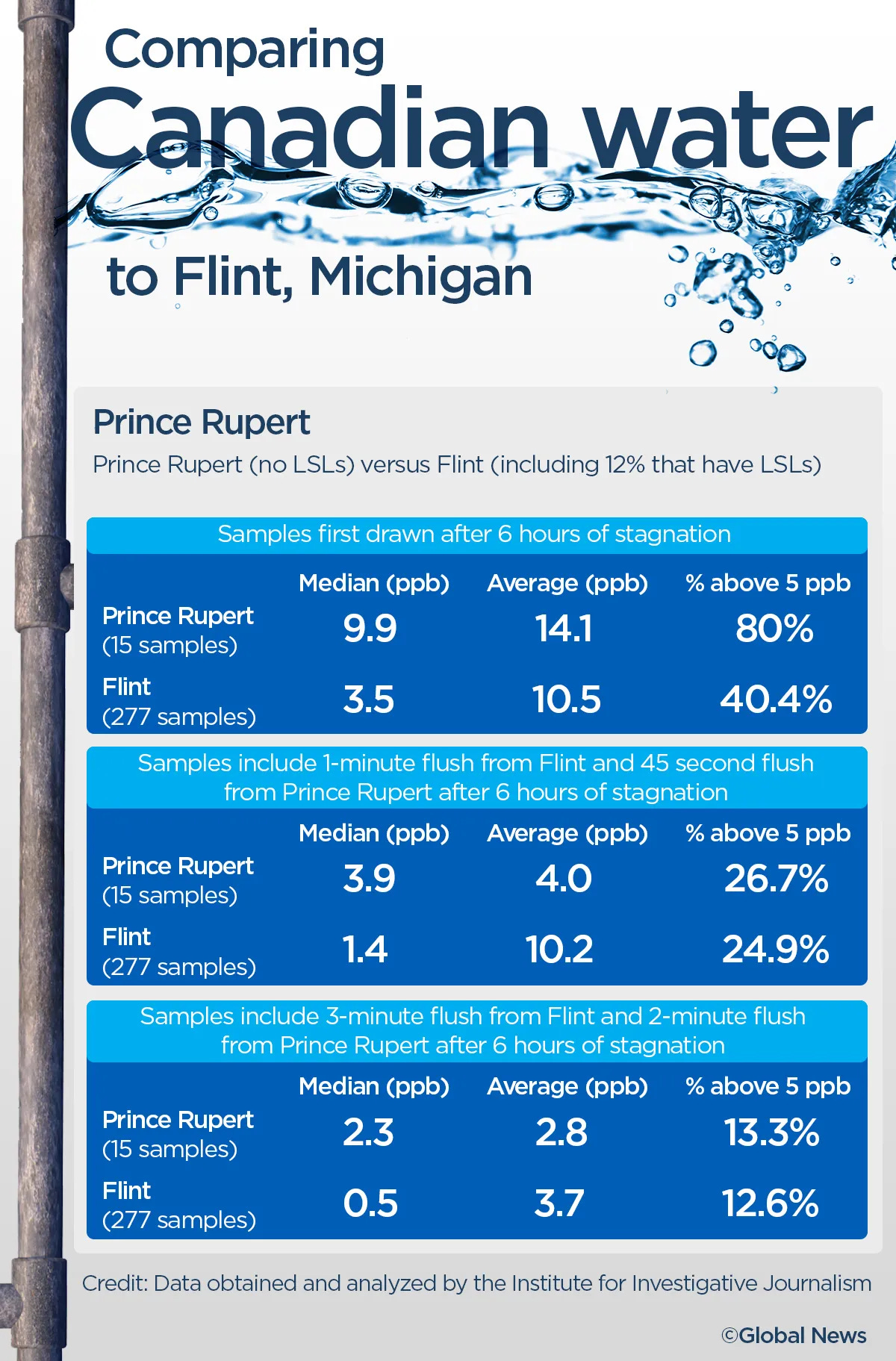
Lead in Canada’s drinking water:
“Hundreds of thousands of Canadians could be consuming tap water laced with high levels of lead leaching from aging infrastructure and plumbing, a large collection of newly released data and documents reveals.”
Arsenic in Canada’s drinking water:
“Arsenic can get into drinking water from natural deposits or runoff from agriculture, mining and industrial processes. In British Columbia, natural minerals are the most common sources of arsenic in drinking water.”
Pharmaceuticals in Canada’s drinking water:
“In Canada, as many as 20 pharmaceutically active compounds (PhACs) have been detected in samples of treated drinking water.”
Multiple pesticides, including glyphosate, in Canada’s drinking water (and water treatment didn’t reduce pesticide concentrations at all, and sometimes increased them!!!):
“Post conventional treatment analysis revealed no significant decrease in the total concentrations of target pesticides and transformation products in drinking water. Notably, 11 pesticides (such as atrazine, mecoprop) and 1 TP (desisopropylatrazine) showed higher concentration in drinking water than in surface water.”
Grant obviously has different priorities for water than I do. He’s okay with exposing himself, his family, and his readers to whatever toxic metals are in their tap (or well) water, because people would get various amounts of calcium out of the deal.
Why is this? Because any water filtration approach that leaves the “good” minerals in, also leaves the BAD minerals in as well.
For me and my people, I would rather aggressively filter my water using reverse osmosis or distillation so that I KNOW we aren’t putting a soup of toxic metals, pesticides, pharmaceuticals, rocket fuel, and who knows what else into our bodies…and then we can deal with good mineral issues later via food choices and/or supplements as necessary. I cover some of these in my calcium livestream linked above.
Simple and easy solutions to health issues—like drinking & bathing water choices— are not always available to us modern city-dwellers. Choices must be made. Choices have consequences. Such is life.
In fact, someone could do the “prison diet” as well as possible…yet if they were using toxic tap water over many years to cook their beans, cook their rice, bathe in, drink, and as the liquid to make their thrice-daily “soup” of meat & beans & rice…they could potentially slowly poison themselves over time in multiple ways that have absolutely nothing to do with “vitamin” A toxicity.
Clearly, in some cases, toxic tap water is indeed ruining the low vA diet.
If all that wasn't bad enough, next you’re going to see Grant’s own “niacin-as-villain origin story," where he attributes his issues to the wrong cause…yet again.
To Be Continued in Part 5, With More on Fortified Foods and Nicotinic Acid…

Written by Garrett Smith