La Folie de Génereux - Part 1 of 6, a Response to Grant Genereux's "Are Supplements Ruining the Low Vitamin A Diet?"
Originally posted on Substack on September 16, 2025
Jump To: Part 1, Part 2, Part 3, Part 4, Part 5, Part 6...as responses to Grant’s article here.
I never thought I’d have to write something like this, yet here we are.
Let me begin this article by saying that I will forever be grateful to Grant for his outside-the-box thinking, along with his brave self-experimentation that led us to realize that “vitamin” A is not essential to human biology and is only a toxin that is best minimized. People know that I have regularly mentioned and praised him by name for these things. He’s been a guest on my YouTube channel twice (2020 and 2025, just 5 short months ago). This movement he started is a valiant pursuit, and nothing I’m about to say takes anything away from that.
That said, I feel compelled to answer his recent opinion/smear piece with evidence, logic, and hard research. I’ll be quoting Grant directly from his recent blogpost “Are Supplements Ruining the Low Vitamin A diet?” (these will be indented as block quotes), e-books, and past emails between him and I, in order to set the record straight. While I am not specifically mentioned by name, people in the low “vitamin” A aka “low vA” community know that this article was mainly pointed at me.
Let’s begin.
On “Fish Stories” and Selective Memory
 “Rosy retrospection” - when people recall past events as being more positive, exciting, or successful than they actually were
It begins with Grant rehashing a 2024 blog post of his:
One of the criticisms made against the low vitamin A diet theory in Jay Feldman’s and Mike Fave’s 2024 hit-piece videos was that the diet was not working fast enough.
I addressed that criticism by explaining:
Firstly, we don’t really know how long it should take to recover from vA toxicity damage because it has never been done before on a wide scale.
More importantly, since everyone is coming into this with vastly different dietary histories, ages and backgrounds it is impossible for there to be a standard recovery timeframe.
Lastly, what is documented in the literature is that the damage caused by vA toxicity is often permanent.
However, Jay and Mike are partially correct too. Yes, it is often taking too long, or worse. As I explained in my Tackling the Detox Setback blog post:
Of course, it would be fantastic if most people could take on this diet and just reliably see their health slowly improve. Then, regardless of how long their health recovery takes, the low vA diet would be far more acceptable. Although a slow steady recovery has been the experience for many people, it’s too unpredictable and too random.
Above, Grant states the following about what many in our low vA community refer to as the “prison diet” approach (red meat, beans, and rice, all day, every day), paraphrased:
-
No distinct, consistent timeline for recovery exists yet. This is true. Back in 2020, I invited Grant as a guest on my YouTube channel so that he and I could attempt to provide people with realistic health recovery timeline expectations.
-
Everyone is different, which massively affects the first point above.
-
It is possible that some damage from “vitamin” A toxicity is permanent (aka it will never go away no matter what is done).
-
Recovery for some “is often taking too long, or worse”, and results are “too unpredictable” and “too random”.
Via his own quote from his 2019 “Tackling the Detox Setback” blogpost above, Grant has been aware of health recovery “often taking too long, or worse”, for a very long time now. Let’s expand upon this. Quoting him from a 2019 email conversation he and I had:
“Hi Garrett,
I wanted to let you know that I really appreciate all the hard work you’ve been putting into raising the awareness, and your additional investigations, of the vitamin A toxicity issue. I think there are now a lot of people onboard, and we (collectively speaking) have very little doubts about WHAT is poisoning us. But, I consider this to be just phase I of the investigation.
For many people their actual recovery is very slow. Like glacially slow. Although that’s not really unexpected, there are other people reporting major improvements in as quick as six months. Some others are only now seeing big improvements, and they are at the two-year point. As you’ve seen, and very unfortunately, some people actually initially start out making good progress, only to then slip backwards into worse health. So, the results, and the timeframes, are a bit all over the map. That’s not too unexpected either because everyone is coming into this from their own unique backgrounds, dietary histories, and saturation levels.
Therefore, I see us now needing to move into phase II. In this phase we need to find faster and safer ways for people to detox and start to predictably and more reliably recover their health. Obviously, using a restricted diet alone is far less than ideal and just takes way too long. What would be ideal is finding a reliable and safe antidote or agent that would help dispose of stored vitamin A faster. I know you’ve been looking into this, and many other aspects of it. I think your efforts in this area are really important. Although my time is quite limited these days, please let me know if there is anything I can help you with. I hope you continue to see support from others helping you in your efforts also.”
In the second paragraph above, back in 2019, Grant was again observing (paraphrased):
-
The results and timeframes have never been as consistent or fast as he’d like
-
(Regarding slow recoveries) “Although that’s not really unexpected…” = It is actually expected
-
(Regarding inconsistent/unreliable results) “That’s not too unexpected…” = It is actually expected
-
-
Some people are experiencing slow recoveries, “Like glacially slow”
-
Some people only see “big improvements…at the two-year point”
-
Some people make good progress, “then slip backwards into worse health”
We see that Grant’s complaints now in 2025 are consistent with his complaints in 2019. What has he changed about his approach since then? Nothing truly significant, other than him adding an unspecified source of an unspecified amount of mineral water 3 years ago. Why would the results be expected to change in any meaningful way either?
"If you keep doing what you've been doing, you'll keep getting what you've been getting” applies perfectly here. So does that good ol’ definition of insanity.
There are a multitude of potential reasons why Grant’s original, simplistic, restrictive “prison diet” approach might not work for every single person. I will cover some of these below.
Also note that Grant intensely wants this process to be sped up (don’t we all!), and he believed back then that my efforts into finding a solution that involved a reliable and safe antidote or agent—implying a supplement or medication—that would help dispose of stored vitamin A faster were really important.
People, especially my happy clients & customers, know that I have diligently kept working over the years at doing just that.
Now for some timeline clarifications:
-
Grant’s first e-book “Extinguishing the Fires of Hell” was first posted on his website in October of 2016.
-
I started my own low “vitamin” A nutrition journey in September of 2018, two years later.
-
The first appearance of the words “detox setback” on Grant’s website were on February 5, 2019, 6.5 years ago. This means that his e-book had only been public for less than 2.5 years before he had observed enough people having slow progress/no progress/backward-sliding issues to write a blogpost about it.
-
The Nutrition Detective Lactoferrin supplement was first made available in January of 2022.
-
The Nutrition Detective Flush Niacin supplement was first made available in February of 2025, as in earlier this year.
This timeline is very important here. Grant noted plenty of issues with the “prison diet” approach long before me or my supplements were significantly involved. Why start the scapegoating now?
On to Grant’s global assessment of things based on his email inbox…
The Good News
The low vA diet is indeed working for a lot of people. About this time last year I had received a bit of a flurry of very positive progress reports. I was getting a new report about once a week, and from people from all over the world, saying that they were making great progress in recovering their health. This year I’m still getting such reports, but the pace has slowed down to maybe one every two or three weeks. So, there’s no doubt that the low vA diet works for some people. Although these progress reports are great, I think the overall success rate is still far too low.
Is the frequency of voluntarily-sent emails received in anyone’s inbox a legitimate or reliable source of anything scientific at all? The answer to this question is a very solid NO.
Grant states again in 2025 that the “overall success rate is far too low”, which continues his 2019 opinion. Nothing has changed. What is he basing his expectations on? It’s definitely not based on, say, 19 years of directly working with people in health and medicine—in person and virtually—plus 12 years of working with people as a personal trainer before that, like I have under my belt.
Without Attention, Even the Strongest Flame Flickers Out
Are there logical reasons why Grant might be getting fewer emails over time? Let’s run through some possibilities:
-
The initial “shine” and excitement about this new discovery has worn off. It has been 9 years since his first e-book came out.
-
He does no marketing or outreach other than being asked to be a podcast guest on occasion, along with his blogposts (7 total in 2024) and extremely sporadic comments on his own forum. He is not exactly a riveting or charismatic guest on podcasts.
-
He has not contributed any significant revelations or discoveries to the low “vitamin” A world since his magnum opus e-book trilogy, the most recent one on breast cancer being published 7 years ago in 2018. Those contributions—which were and still are extremely important—can be summed up as “vitamin A is a toxin, humans don’t need any of it, eat red meat & beans & rice forever to regain your health, until you either quit the diet or pass away of old age.”
-
Grant maintains no known social media presence.
-
Grant’s own neglected forum (admitted by him in this video just 4 short months ago, which I kindly helped facilitate his appearance on) platforms trolls and antagonists of this movement who constantly speak poorly of both Grant and I, the low vA approach, along with pushing “vitamin” A consumption via the two most allergenic foods known to mankind, eggs and dairy. You can find some of these folks in the comment section of his blogpost we’re discussing now. His own forum is practically an advertisement for people to NOT choose this approach. Sad, really.
-
His ability to troubleshoot the inevitable health issues that may come up for each individual is limited due a lack of background in working with individuals on health issues (he’s an engineer by trade), the incomplete/slow/tedious nature of email troubleshooting (I know this from my own experience), and the rigid, extremely limited “prison diet” approach.
-
Successful entrepreneurs know that if one doesn’t continue to pump life into a movement somehow, it slowly (or quickly) dies on the vine.
One might then wonder, who has kept this movement moving forward then?
I’ve been moving it forward, with large following on YouTube (since 2018, with 4+ years straight of weekly livestreams) and Twitter (see my pinned thread of threads), a virtual practice that does blood and hair testing along with including 6 months of small group support/troubleshooting with every package, and continuing to work on uncovering the highest-potency “antidotes and agents” in the research that accelerate the “vitamin” A detox process, and then making them available as super-clean-ingredient supplements. All of this is means I have skin-in-the-game.
Potential Non-”vitamin” A-Related Issues From the “Prison Diet”
Now, I’m going to explain how people could develop legitimate issues over time on the hyper-repetitive “prison diet” of beef or bison, black beans, and white or brown rice. I’ve never heard Grant discuss or troubleshoot issues like these that can and do come up for some people on the “prison diet”…yet I do this type of troubleshooting all the time! Let’s go:
-
Some people (not many) are EXTREMELY efficient at absorbing heme iron from red meat. These folks’ ferritin (“storage iron”) rises very rapidly on a high red meat diet, and they start getting symptoms of iron overload aka hemochromatosis over time. These symptoms will continue to worsen over time, until they either realize they don’t feel good when they eat red meat too often or they do a ferritin test with an educated & experienced practitioner in this area (I know where you can find them). This scenario doesn’t happen often, yet it does happen! If this happens to a handful of people, should everyone stop eating red meat? Hardly.
-
These folks then generally move to poultry (chicken, turkey, etc.) and the iron overload issue greatly improves over time. Poultry is ~10x lower in zinc than red meats though. Will their muscle meat change continue to get them enough zinc? What do they need to do if they cannot eat red meats, yet they don’t get enough zinc from poultry? Will it continue to get them enough Calories, since chicken can be drastically leaner than red meat?
-
-
Fats, including those in red meats and oils, can cause bile dumping. The main source of fat on the “prison diet” are from muscle meats (mainly red meats) or possibly some added oil (Grant has mentioned previously using ~1 Tbsp of olive oil a day for cooking his meat). Should people not eat fat or oil because Grant is concerned about anything that “promotes rapid bile dumping and that’s pretty much the last thing we want to do when we are sick”?
-
Soluble fiber, which is high in beans, also can cause bile dumping. Beans are the main and only significant source of soluble fiber on the “prison diet”. Should people not eat soluble fiber because Grant is concerned it “promotes rapid bile dumping and that’s pretty much the last thing we want to do when we are sick”?
-
Some people simply don’t tolerate beans/legumes for any number of reasons. They just don’t, at least not in the beginning phases when they are more toxic. What do they do then?
-
Some significantly copper-toxic people do not tolerate beans/legumes because of the copper in them, while others are fine. What is to be done for them?
-
Some people poop better with more soluble fiber, some people poop better with little to no fiber. If a person’s chosen diet is continually inducing constipation, this is directly anti-health and anti-detox, and would increase issues over time.
-
-
Rice, especially white rice, is a well-accepted cause of constipation in some people. So much so that it is commonly recommended as a food to eat to counter diarrhea as part of the “BRAT diet”. Constipation is a significant roadblock to detox. What do constipated people do if rice stops them up?
-
Rice is often a significant source of arsenic and can lead to toxicity when consumed daily long-term (reference, reference, reference, reference, reference). What happens to someone who does well on the “prison diet” in the beginning due to decreasing their “vitamin” A toxicity, yet because of a lack of awareness, laziness, or denial of the very real arsenic issues in rice, they slowly poison themselves over time and appear to “slip backwards” because of chronically developing arsenic toxicity? “vitamin” A toxicity and arsenic toxicity share many of the same symptoms, so this would be an extremely confusing issue to those unaware of it.
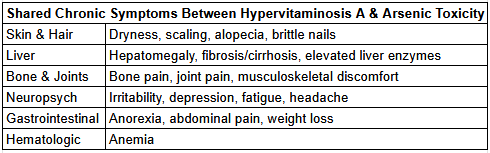
Patterns, patterns, everywhere -
The arsenic issue concerned me so much that I did a whole livestream on research-based methods to reduce the arsenic content of rice at home, and I have verified that these work in the real world via hair testing for arsenic.
-
-
It seems that Grant likely had a functional zinc deficiency early on in his meat-heavy “prison diet”, because he supplemented 50mg of zinc once-every-two-weeks during his first year and his “inflammation had subsided“ for days each time he took it. This will be covered in detail later. How is zinc status to be assessed? If deficiency is found, how is it to be addressed?
-
The arsenic in rice depletes zinc further for a double whammy in the wrong direction. What is Grant’s zinc status 9 years later, when he is now consuming less red meat than he did back then, along with ten years of rice (arsenic) consumption along the way?
-
These are only the tip of the iceberg of nutrient deficiencies, toxicities, and other issues that could cause people slow progress, no progress, or even to go backwards on the “prison diet”. There is no one-size-fits-all nutrition approach in today’s modern world, especially not for chronically ill, nutrient-deficient, and/or very toxic people.
When Health Goals Collide with Human Flaws
In addition to the legitimate biochemical and physiological reasons I gave above, there are other reasons are there that might explain why some people get slow results, no results, or even slide backwards doing ANY dietary approach…even if it was a perfectly-prepared and individually-optimized program made just for them:
#1 - Good Ol’ User Error
As in, when people are given clear instructions and still screw them up for any number of reasons. This happens all the time! How often, you ask? From the article 10 Benchmarks for User Experience Metrics:
“The average number of errors per task is 0.7: Across 719 tasks of mostly consumer and business software, we found that by counting the number of slips and mistakes about two out of every three users (2/3) had an error. Only 10% of all tasks we’ve observed are error-free or, in other words, to err is human.”
That is a shockingly high rate of error. Combine that with Murphy’s Law, which states that “anything that can go wrong, will go wrong”, we’re not off to a great start. Whenever reading reviews of anything, never forget to factor in user error.
#2 - Neuroticism and Dodging Accountability
Let me introduce the idea of “health neurosis”, and the “health neurotics” who firmly dwell in this health arena. This is based on Karen Horney’s work in her own magnum opus, “Neurosis and Human Growth” (highly recommended reading). The definition of a health neurosis would basically be as such:
Health neurosis (n.) – A compulsive, anxiety-driven preoccupation with perfect health, in which the individual rigidly pursues “shoulds” about well-being, makes health a measure of worth, and externalizes blame for any failure onto outside factors rather than acknowledging inner conflicts.
Externalizing blame for failure seems pertinent to this article in more ways than one.
These health neurotics—in their forever-futile pursuit of perfect health—won’t ever get fully better until they deal with their inner conflicts, aka mental/emotional/spiritual issues. They will blame anyone and anything else—other than themselves—for why they aren’t perfectly healthy yet.
#3 - Dishonesty
Finally, people (patients) purposely lying by commission or omission to other people (ie. practitioners), especially in the health arena. A study of 4500+ people found that 82% of the people surveyed concealed relevant information from their physicians either by outright lying or not telling them. Why did they do this? The top reasons included:
-
Not wanting to be judged or lectured about their behavior
-
Wanting to avoid hearing how bad the behavior is
-
Feeling embarrassed
-
Not wanting to be seen as a difficult patient
Do real people have real health problems? Of course they do. That’s what we’re trying to help humanity with via this work! That said, should we believe everything a random person sending an email says, just because they say they’re doing low vA nutrition? Based on those statistics above, the answer should never be an automatic yes. My father taught me this saying: “Believe nothing of what you hear, and only half of what you see.” This is useful advice still today.
To summarize the above:
-
People make mistakes all the time and blame others for their mistakes
-
People have very real mental/emotional issues, especially in these “interesting times”
-
People will lie and/or conceal information that makes them look bad
Is the low “vitamin” A diet working for most people? Yes, absolutely! That is why this movement continues to grow daily.
Will the low vA approach work amazingly for every single person out there? NO, it will NOT, because not everyone’s MAIN health problem is “vitamin” A toxicity (yes, I said it!!!). While we’re here, let’s cover some more possibilities:
-
Some people are getting poisoned by things in their their local environment that have nothing to do with “vitamin” A toxicity or their diet at all. Mercury amalgam fillings, toxic water supplies, and/or mold toxicity where they live or work, are but a few examples.
-
If one of these issues suddenly showed up years into someone doing low vA (they move into a new house or apartment, for example), it could LOOK like they “slipped backwards” in health, yet it is a NEW problem and has NOTHING to do with their DIET.
-
I mention in the very beginning of my program that these specific issues need to be dealt with as soon as possible, and not ignored.
-
-
Some people will literally think themselves into being sick (the opposite of placebo effect).
-
Some people’s health problems are so rare and/or complex that they will never be figured out.
-
Some people identify with their disease so much that they actually don’t want to get well and will self-sabotage anything that is actually working.
-
Some people are not intelligent enough to follow simple instructions properly, or refuse to follow the instructions, yet claim they did to avoid embarrassment.
These are just some of the myriad of reasons why no approach or practitioner will ever help fix every single person.
More of the Same
The Bad News
Over the last few years I’ve become aware of cases of people on the low vA diet, and although they may have had some initial success, where their progress quickly stalled. For some people their health then took a major step backwards. In my opinion that’s completely unacceptable. For this project to be a success most people need to experience a positive result.
Since hard numbers are not provided in Grant’s article, and unknown statistics based on Grant’s testimony, email inbox, and memory are all we have to go by, let’s clarify the terms he uses above.
“Some” = One or more, and less than 50%.
“Most” = A majority, greater than 50%, yet not 100%.
To reiterate, Grant has known about and admitted these exact same issues since 2019! It’s not just the last 2-3 years. Most people ARE experiencing a positive result, assuming one understands that “most” by definition means more than 50%!
The low vA movement is GROWING because it WORKS, it’s simply not showing up often enough in Grant’s personal inbox for his taste, likely for the reasons I gave above.
We are likely witnessing a real-life “fish story”, where Grant’s selective memory and interpretation is minimizing old problems while maximizing past successes.
To be continued…

Written by Garrett Smith