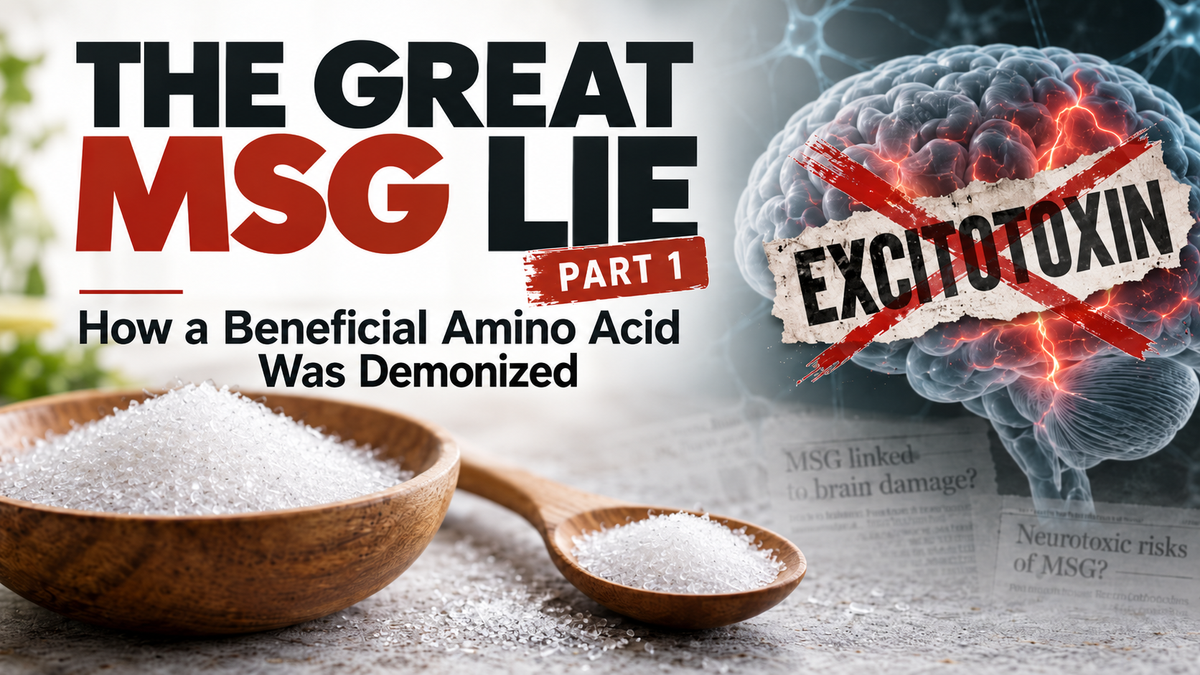
The Great MSG Lie PART 1: How a Beneficial Amino Acid Was Demonized as a Brain-Damaging “Excitotoxin”
What if one of the most demonized food ingredients of the last 60 years was actually something your body WANTS?

What if the supposedly dangerous “excitotoxin” monosodium glutamate (MSG) was an important source of an amino acid that your intestines use for energy, your body manufactures through multiple biochemical pathways, and human breast milk contains in surprisingly large amounts?
And what if the original experiments used to frighten people about MSG involved injecting huge amounts into newborn animals, while researchers feeding MSG to animals found NO corresponding brain damage?
It gets better.
Human experiments have involved feeding people as much as 147 GRAMS of glutamate per day, without any neurological damage that MSG critics would have you expect.
Researchers have found that MSG users don’t accumulate glutamate in their blood.
Blinded experiments have repeatedly failed to reproduce the supposedly characteristic MSG reactions.
And researchers have demonstrated that regular MSG exposure can actually REDUCE people’s desire for savory foods.
So how did we get from all of that to the belief that MSG is some terrible poison?
That’s what we’re going to examine.
Kelsey Kenney, our main health consultant/facilitator, has been digging into glutamate research for quite some time. What she discovered eventually convinced me to reconsider some of my own assumptions about MSG.
I was initially hesitant.
Like many people in the natural health world, I’d heard the MSG horror stories.
But when I started reviewing the actual research, the picture changed dramatically.
I also began realizing that many of the foods I’d been craving throughout my own low-”vitamin” A journey happened to be rich in glutamate.
Interesting coincidence?
I don’t think so.
What we’ve been discovering has implications extending far beyond whether you should sprinkle MSG on your dinner.
Glutamate is involved in digestion, energy metabolism, amino acid metabolism, glutathione production, and numerous other biological processes.
And the more you investigate those processes, the less sense the simplistic anti-MSG narrative makes.
Let’s start with the basics.
Watch the Original MSG Investigation With Kelsey and I
Kelsey Kenney and I presented the research behind the MSG scare, discussed the original animal experiments, reviewed the human feeding studies, and shared the experiences that led us to begin investigating MSG more seriously.
We also discussed the relationships between glutamate, copper toxicity, zinc metabolism, menstrual bleeding, and liver function.

MSG Is an Amino Acid and a Mineral. What’s So Scary About That?
Monosodium glutamate is the sodium salt of glutamic acid.
When MSG dissolves, it separates into sodium and glutamate.
Sodium is a mineral electrolyte.
Glutamate is an amino acid.
That’s what we’re talking about.
MSG isn’t some exotic mystery chemical that your body has never encountered.
Glutamate is present naturally in countless foods, including meat, tomatoes, mushrooms, cheese, and other protein-containing foods.
Your body also MAKES glutamate.
Lots of it.
In fact, glutamate is one of the most abundant amino acids in the body and participates in an extraordinary number of biochemical reactions.
A review titled Glutamate: A Safe Nutrient, Not Just a Simple Additive discusses glutamate’s nutritional and metabolic functions.
Notice the title.
A SAFE NUTRIENT. NOT JUST A SIMPLE ADDITIVE.
Glutamate participates in energy production, protein synthesis, nitrogen handling, and the formation of other important molecules.
It’s also involved in the production of glutathione, which is extremely relevant to my work involving liver function and detoxification.
But first, an important distinction.
When I say MSG, I mean actual monosodium glutamate powder.
I’m NOT talking about eating a bunch of junk food because the ingredient label happens to contain MSG.
I’m also not talking about all the additives that people claim are “MSG in disguise”.
I’m NOT recommending greasy restaurant food loaded with added fats.
And I’m certainly not telling people to start eating high-”vitamin” A or high-copper foods just because they contain glutamate.
Those are entirely different issues.
We’re talking about adding a specific amino acid salt to foods that are otherwise compatible with a healthy diet.
Keep that distinction in mind throughout this article.
MSG Has Been Sold Since 1909. Why Did the Panic Start Nearly 60 Years Later?
In 1908, Japanese chemist Kikunae Ikeda identified glutamate as the compound responsible for the savory taste of kombu seaweed broth.
He called the taste umami.
MSG was subsequently commercialized in 1909 under the name Aji-no-moto.
And people began using it to flavor food.
Fast-forward nearly 60 years.
In 1968, a physician named Robert Ho Man Kwok wrote a letter to the editor of the New England Journal of Medicine describing symptoms he sometimes experienced after eating at Chinese restaurants.
The letter helped launch what became known as “Chinese Restaurant Syndrome.”
You can read the original 1968 letter here.
The symptoms associated with the syndrome included headaches, numbness, tingling, flushing, and weakness.
MSG was one of several suspected causes. Other potential causes mentioned by the author included acetylsalicylic acid (aspirin), cooking wine (alcohol and/or sulfites), and/or excessive sodium.
The following media hysteria focused on only one thing though, and that was MSG.
Before long, the accusations were everywhere.
MSG supposedly caused headaches.
MSG supposedly caused brain damage.
MSG supposedly caused obesity.
MSG supposedly caused neurological problems.
But here’s a question.
MSG had already been sold for nearly 60 years before this supposed syndrome became famous.
It took THAT long for people to recognize this alleged widespread problem?
And why was an entire cuisine being blamed?
Chinese restaurant meals can contain all kinds of ingredients.
Cooking wines.
Soy sauce.
Sulfites.
Wheat proteins.
Hydrolyzed proteins.
Fermented ingredients.
Added fats.
And numerous other substances.
Some of those ingredients may cause symptoms in susceptible individuals.
So how did MSG become the universal scapegoat?
Apparently, the temptation to blame one ingredient was just too great.
But the really interesting part of the MSG scare came shortly afterward.
That’s when researchers began injecting MSG into newborn animals.
The Famous MSG Brain Damage Study: They INJECTED It Into Newborn Mice!
In 1969, researcher John Olney published:
Brain Lesions, Obesity, and Other Disturbances in Mice Treated with Monosodium Glutamate.
This became one of the classic papers underlying the excitotoxicity fears surrounding MSG.
The researchers reported neuronal damage in newborn mice.
They also reported subsequent abnormalities involving obesity, skeletal development, and reproduction.
Pretty frightening stuff.
Until you look at what they actually did.
The paper describes:
“subcutaneous injections of monosodium glutamate”
INJECTIONS.
Into newborn mice.
They weren’t feeding ordinary amounts of MSG to healthy adult animals.
They weren’t studying people who sprinkled MSG on their food.
They bypassed the gastrointestinal tract and injected MSG directly into extremely young animals that did not have their blood-brain barrier fully formed yet.
And then the findings became part of the argument that dietary MSG damages the brain.
Seriously? Sounds like a setup to me.
Kelsey Found Problems With the Experimental Design
When Kelsey reviewed the original paper, she noticed that the controls were not subjected to equivalent injection procedures.
The reported experiment included MSG-injected animals and untreated controls.
That raises an obvious methodological question.
Why weren’t the controls receiving comparable injections without MSG?
Kelsey also examined the tissue preparation methods, including the use of glutaraldehyde.
Glutaraldehyde is a reactive aldehyde commonly used as a tissue fixative. Aldehydes are toxic to tissues.
She questioned how these methodological details might have influenced the interpretation of the findings.
But we don’t even have to settle those questions to recognize the major problem.
Injecting huge amounts of MSG into newborn animals is NOT THE SAME THING as eating MSG.
Why does that distinction matter so much?
Because the digestive system metabolizes enormous amounts of dietary glutamate before it reaches the bloodstream.
We’ll get into that shortly.
First, let’s look at what happened when researchers FED MSG to animals instead.
The Animal Feeding Experiment That Found NO Brain Damage
This is one of the most revealing comparisons in the entire MSG controversy.
In 1978, researchers published a paper titled:
Look at that title.
ABSENCE OF BRAIN DAMAGE.
The researchers fed mice diets containing 5%, 10%, and even 15% MSG by weight.
We’re not talking about a little MSG seasoning here.
These were extremely high dietary exposures.
Reported intakes reached approximately 14–43 grams per kilogram of body weight daily, depending on the group.
The investigators examined pregnant animals, developing offspring, and weanling mice.
What did they find?
They reported:
“no pathological changes in the hypothalamic arcuate nuclei”
But when MSG was administered by injection, the characteristic brain lesions appeared.
Now look at this.
MSG given through the digestive tract?
No corresponding hypothalamic lesions under the feeding conditions tested.
MSG injected into newborn animals?
Brain lesions.
SAME SUBSTANCE. DIFFERENT ROUTE OF ADMINISTRATION. VERY DIFFERENT RESULTS.
How does somebody use the injected-MSG experiments as proof that MSG in food is dangerous while ignoring the feeding experiments?
You can’t reasonably interpret one without considering the other.
And once we examine intestinal glutamate metabolism, the reason for the difference becomes much easier to understand.
Your Intestines Are DESIGNED to Use Glutamate
People have been taught to imagine that eating MSG floods their bloodstream with glutamate, which then travels into their brain and causes neurological damage.
That’s not how normal dietary glutamate metabolism works.
A major scientific review titled Metabolism of Dietary Glutamate in Adults describes extensive glutamate metabolism in the splanchnic region, which includes the intestines and liver.
The authors wrote:
“almost no glutamate appears in the systemic circulation.”
Read that again.
The digestive system processes most dietary glutamate before it reaches the general circulation.
Glutamate isn’t simply passing through your intestines on its way to your brain.
Your intestinal cells are actively USING IT.
Another paper, Metabolic Fate and Function of Dietary Glutamate in the Gut, describes glutamate as:
“a major oxidative fuel for the gut”
That’s right.
Your gut uses glutamate for ENERGY.
Research indicates that approximately 90% of dietary glutamate can be metabolized during its first pass through the splanchnic tissues.
That’s an enormous proportion.
Now consider what this means.
People spend incredible amounts of money on supplements intended to support intestinal function.
They buy all kinds of products for their gut lining.
But how many understand that glutamate is one of the important energy substrates used by the intestinal cells themselves?
Glutamate contributes to intestinal energy production and provides substrates for other metabolic reactions.
A review titled The Roles of Dietary Glutamate in the Intestine discusses these functions in detail.
Your gut doesn’t simply tolerate glutamate.
It actively metabolizes it.
And glutamate’s functions in the digestive system go beyond energy production.
Your Tongue Has Specialized Receptors for Glutamate. WHY?
Here’s something else that should get your attention.
Humans have taste receptors that respond to glutamate.
That’s the basis of the umami taste.
Research on metabotropic glutamate receptors in taste tissue helped establish the biological mechanisms involved in detecting glutamate.
Researchers have identified several receptor mechanisms involved in umami perception, including taste receptor systems that respond to glutamate.
Now think about that.
Your body has specialized mechanisms for recognizing glutamate in food.
Why?
Because glutamate provides information about the food you’re eating.
Umami is strongly associated with savory, protein-containing foods.
And protein is fundamental to human nutrition.
Kelsey brought up a particularly interesting explanation during our livestream.
The ability to recognize glutamate may help prepare the body for protein digestion.
When you taste glutamate-rich food, you’re activating sensory pathways that can communicate information about incoming nutrients.
This is connected to digestive signaling and the parasympathetic nervous system.
Glutamate May Help Prepare Your Digestive System for Food
Umami taste receptors participate in nutrient sensing.
The gastrointestinal tract also has systems that respond to amino acids and other food components.
These signals can influence digestive secretions, gastrointestinal motility, and communication with the nervous system.
One human study was titled:
Monosodium Glutamate Raises Antral Distension and Plasma Amino Acid After a Standard Meal in Humans.
Researchers investigated the effects of adding MSG to a meal on gastric physiology and postprandial amino acid concentrations.
They reported changes in antral distension and circulating amino acid responses.
This is especially interesting because it demonstrates measurable physiological responses to dietary MSG.
We’re not merely talking about making food taste better.
We’re talking about the digestive system responding to glutamate.
Another experimental study, Both Dietary Supplementation with Monosodium L-Glutamate and Fat Modify Circulating and Tissue Amino Acid Pools in Growing Pigs, but with Little Interactive Effect, investigated how dietary MSG influences amino acid availability.
The researchers found that dietary MSG altered amino acid pools in circulating blood and tissues.
Again, glutamate is participating in normal metabolism.
This is why I think the entire conversation surrounding MSG needs to change.
Instead of automatically asking how glutamate might hurt us, we should be asking what biological functions glutamate is helping us perform.
The Blood-Brain Barrier: Another Major Problem With the Excitotoxin Story
Glutamate is an important excitatory neurotransmitter in the brain.
That’s the part everyone seems to know.
But here’s what gets overlooked.
Dietary glutamate and glutamate neurotransmission inside the brain are NOT the same exposure.
The brain regulates glutamate concentrations through specialized transport systems and cellular mechanisms.
The blood-brain barrier also helps regulate movement between circulating blood and brain tissue.
A review titled Glutamate as a Neurotransmitter in the Brain: Review of Physiology and Pathology discusses glutamate’s normal neurological functions and its relationship to pathological conditions.
The important distinction is between glutamate operating within regulated physiological systems and abnormal glutamate exposure during experimental or pathological conditions.
When researchers inject MSG into newborn animals, they are creating a very different exposure from ordinary dietary consumption.
Your intestines don’t get bypassed when you sprinkle MSG on your dinner.
And your blood-brain barrier doesn’t simply disappear.
The Firefighters Didn’t Start the Fire
Kelsey brought up an analogy that I think is worth remembering.
Researchers often observe increased glutamate activity in damaged or oxygen-deprived tissues.
They then associate glutamate with the injury.
Yet glutamate is also involved in energy metabolism and cellular responses to stress.
Its presence during tissue injury doesn’t automatically tell you what initiated the problem.
It’s like seeing firefighters at a burning building and deciding that the firefighters must have started the fire.
That’s not how you establish causation.
You need to understand the actual sequence of events and the physiological context.
And in the case of MSG, the context of dietary exposure has repeatedly been overlooked.
Human Breast Milk Is LOADED With Free Glutamate
Now here’s where things get particularly interesting.
If glutamate is supposedly so dangerous to the developing nervous system, why does human breast milk naturally contain enormous amounts of it?
I’m not talking about glutamate bound within proteins.
I’m talking about FREE GLUTAMATE.
The same glutamate your body receives when MSG dissolves.
A systematic review titled Amino Acid Profiles in Term and Preterm Human Milk through Lactation examined amino acid composition in human milk.
The researchers reviewed 83 studies and summarized data from thousands of mothers.
They found that glutamate was the most abundant free amino acid in human milk.
The authors reported:
“The most abundant was glutamate”
They found free glutamate concentrations ranging from approximately 960 to 1,529 micromoles per liter in mature human milk.
And here’s another fascinating detail.
Glutamate concentrations INCREASED as lactation progressed.
Many free amino acid concentrations declined.
But glutamate and glutamine increased during the early months of lactation.
Why would human milk be supplying increasing amounts of these amino acids during infant development?
That’s a question worth asking.
Glutamate Is Approximately 20 Times More Abundant Than Many Other Free Amino Acids
The same systematic review reported that glutamate concentrations were approximately 20 times greater than those of many other free amino acids.
TWENTY TIMES.
This isn’t some insignificant trace substance.
It’s one of the dominant free amino acids in human breast milk.
And remember, we’re talking about the primary food consumed by developing human infants.
Infants who are growing rapidly.
Infants whose intestinal systems and nervous systems are developing.
Infants with substantial nutritional demands.
Yet human breast milk naturally provides substantial amounts of free glutamate.
Does that sound like the body considers glutamate an inherently dangerous substance?
Human Milk Has Much More Free Glutamate Than Cow’s Milk
Another comparison discussed in our livestream involved human milk versus cow’s milk.
Human breast milk has been reported to contain approximately 6–10 times more free glutamate than cow’s milk.
Now consider that.
Human breast milk contains much more free glutamate.
But cow’s milk contains substantially more calcium.
Human milk contains only about one-quarter the calcium concentration of cow’s milk.
Why do these species have such different milk compositions?
Because their offspring have different physiological needs.
Human infants and calves don’t grow at the same rate or follow the same developmental patterns.
The composition of their milk reflects those differences.
And I find the abundance of glutamate in human milk particularly revealing.
Human milk provides substantially more free glutamate than cow’s milk.
That’s not some minor curiosity.
It tells us that free glutamate is a prominent component of normal human infant nutrition.
Glutamate and Glutamine in Human Milk May Help Protect Infants
This gets even better.
In 2020, researchers published:
Look at that title.
PROTECTION AGAINST NEONATAL ALLERGIES AND INFECTIONS.
The researchers investigated the possible roles of free glutamate and glutamine in infant immune and intestinal development.
They discussed evidence connecting these amino acids with intestinal barrier function and immune regulation.
That’s particularly interesting when we remember that intestinal cells use glutamate as a major energy substrate.
The gut lining needs energy.
The immune system interacts closely with the intestinal barrier.
And breast milk supplies large amounts of glutamate during infancy.
Now we’re starting to see a pattern.
Glutamate isn’t merely present in human milk.
It’s being investigated for its potential roles in intestinal development and protective functions.
And yet people have been frightened into thinking that glutamate itself is somehow an inherently dangerous dietary poison.
Something doesn’t add up.
What Happens When Mothers Consume MSG?
One of the arguments made against MSG involves potential harm during pregnancy and breastfeeding.
So what happens when researchers examine maternal glutamate exposure?
In The Safety Evaluation of Monosodium Glutamate, Walker and Lupien reviewed evidence involving pregnancy, lactation, and developmental exposure.
The authors reported that maternal MSG consumption did not simply cause excessive glutamate accumulation in breast milk.
They stated:
“MSG was not associated with elevated levels in maternal milk”
That’s interesting.
Human milk already contains substantial amounts of free glutamate.
Yet consuming additional MSG does not necessarily cause milk glutamate concentrations to rise uncontrollably.
The mammary gland regulates milk composition.
The placenta also regulates the movement of glutamate between maternal and fetal circulation.
In experiments involving pregnant primates, researchers found evidence of restricted placental glutamate transfer even when maternal concentrations were experimentally elevated.
So the body has mechanisms for regulating glutamate exposure during development.
And those mechanisms help explain why dietary glutamate and artificial experimental exposures can produce very different outcomes.
The Human Experiment Involving Up to 147 GRAMS of Glutamate Per Day
This was one of my favorite studies from the original livestream research.
In 1970, researchers published a paper in Science titled:
Monosodium Glutamate: Feeding of Large Amounts in Man and Gerbils.
The investigators administered large amounts of glutamate orally to adult humans and animals.
The experimental intakes discussed in the research reached approximately 25–147 grams daily over periods of roughly two to six weeks.
Think about that.
UP TO 147 GRAMS PER DAY.
For perspective, that’s dramatically more than the amount a person would ordinarily sprinkle onto food.
And what did the researchers find?
Their abstract states:
“appeared to cause no clinical pathological changes.”
That’s a rather interesting finding for a substance we’ve been told is a dangerous dietary neurotoxin.
But here’s the part I found even MORE interesting.
The Researchers Found LOWER Cholesterol!
The researchers reported that the only measurable biochemical effect was a reduction in serum cholesterol and associated beta-lipoproteins.
Their wording was:
“a decrease in serum cholesterol and associated beta lipoproteins.”
Now THAT caught my attention.
We’re talking about extraordinary oral glutamate intakes.
The researchers reported no clinical pathological changes.
And they observed LOWER cholesterol-related measurements.
Why isn’t this study more widely discussed in the context of MSG safety?
Why do we keep hearing about injected MSG experiments in newborn mice while studies involving enormous oral intakes receive comparatively little attention?
If the claim is that dietary MSG is inherently dangerous, this is exactly the kind of research people should be examining.
Long-Term MSG Users Did NOT Accumulate Glutamate in Their Blood
Here’s another paper that deserves attention.
Plasma Amino Acid Patterns and Visceral Protein Status in Users and Nonusers of Monosodium Glutamate.
The researchers compared people who regularly consumed MSG with people who didn’t.
They examined plasma amino acid concentrations and related measurements.
The findings did not demonstrate the pattern of elevated fasting glutamate that one might expect if ordinary MSG consumption caused glutamate to accumulate in the bloodstream.
In one comparison involving women, mean fasting plasma glutamate concentrations were approximately:
-
MSG nonusers: 22.4
-
MSG users: 21.8
Those values were essentially the same.
The MSG users actually had a slightly LOWER mean value.
So where is the supposed glutamate accumulation?
This research fits with what we’ve already discussed.
The intestines metabolize dietary glutamate.
Other tissues participate in glutamate metabolism.
And the body maintains circulating amino acid concentrations through multiple regulatory systems.
Eating MSG does not simply cause glutamate to build up indefinitely in your bloodstream.
That notion doesn’t fit the observed physiology.
Does MSG Really Cause Headaches?
Headaches are probably one of the most common accusations made against MSG.
People eat Chinese food.
They get a headache.
MSG gets blamed.
End of investigation.
But what happens when researchers actually test the claim?
In Does Monosodium Glutamate Really Cause Headache? A Systematic Review of Human Studies, researchers evaluated the evidence connecting MSG consumption with headaches.
The results did not establish a consistent relationship under ordinary dietary conditions.
And another investigation discussed during our livestream examined dietary factors associated with migraine.
Among 227 participants with analyzable data, approximately 3% showed an association between MSG-containing foods and increased migraine risk.
Approximately 96% showed no association.
Two participants even showed an association in the opposite direction.
Think about that.
For the overwhelming majority of participants in that analysis, MSG wasn’t associated with increased migraines.
But the most revealing experiments involved people who ALREADY believed they were sensitive to MSG.
When MSG-Sensitive People Were Blinded, Their Reactions Often Disappeared
In 2000, researchers published:
This study specifically recruited people who claimed to experience adverse reactions after consuming MSG.
That’s important.
These weren’t people who had no reason to suspect MSG.
They were people who believed MSG caused their symptoms.
The researchers administered MSG and placebo under controlled conditions.
Then they repeated the challenges.
Some participants reported symptoms after consuming large amounts of MSG without food.
But when the experiments were repeated, the results were inconsistent.
The researchers concluded:
“the responses were not consistent on retesting.”
READ THAT AGAIN.
People who believed MSG made them sick could not consistently reproduce their supposed reactions under blinded conditions.
And when MSG was consumed with food, the claimed reactions were even harder to establish.
This is a major problem for the idea of a predictable MSG reaction syndrome.
Another Double-Blind Study Found Similar Results
In Monosodium L-Glutamate: A Double-Blind Study and Review, researchers evaluated symptoms following MSG and placebo administration.
The MSG doses ranged from approximately 1.5 to 3.15 grams.
Symptoms occurred at similar frequencies following MSG and placebo.
So if someone doesn’t know whether they’ve consumed MSG, their ability to reliably identify its supposed effects becomes much less impressive.
People can be absolutely convinced that something causes their symptoms.
That doesn’t automatically make their interpretation correct.
And this is particularly important when a substance has been demonized for decades.
What About MSG and Asthma? Another Scare Story That Failed Scientific Testing
MSG has also been accused of triggering asthma attacks.
Bronchoconstriction. Difficulty breathing. Respiratory distress.
Sounds frightening, doesn’t it?
Well, let’s see what happened when researchers actually TESTED these claims.
100 Asthmatic Patients. ZERO Reproducible MSG-Induced Asthma Attacks.
In 1999, researchers published Monosodium Glutamate Sensitivity in Asthma.
They recruited 100 people with asthma, including 30 who specifically reported asthma attacks after eating at Chinese restaurants.
The participants received 2.5 grams of MSG during placebo-controlled challenges.
Remember, these weren’t all people who had never suspected MSG.
Thirty of them already believed that something in Chinese restaurant food triggered their asthma.
What happened?
NONE of the 100 participants demonstrated a reproducible MSG-induced asthma attack.
One participant initially showed a decline in lung function, but the reaction could not be reproduced during subsequent double-blind testing.
The researchers concluded:
“MSG challenges in subjects with and without a perceived sensitivity to MSG failed to induce signs or symptoms of asthma.”
Read that again.
100 asthmatic patients.
Including 30 people with a history of restaurant-associated asthma attacks.
The supposed MSG-induced asthma couldn’t be reproduced.
Researchers Even Tested 5 GRAMS of MSG!
A 1998 randomized, double-blind, placebo-controlled study, The Effects of Monosodium Glutamate in Adults With Asthma Who Perceive Themselves to Be Monosodium Glutamate-Intolerant, investigated 12 asthmatic patients who believed they reacted to MSG.
The researchers challenged them with:
-
1 gram of MSG
-
5 grams of MSG
-
A placebo
They monitored lung function, bronchial hyperresponsiveness, and inflammatory markers.
And what did they find?
“No immediate or definite late asthmatic reactions occurred.”
The researchers also found no significant changes in bronchial hyperresponsiveness or the inflammatory markers they measured.
Even 5 GRAMS of MSG failed to provoke the asthma attacks these individuals believed they were susceptible to.
Another randomized, double-blind crossover study, Airway Effects of Monosodium Glutamate in Subjects With Chronic Stable Asthma, investigated 12 asthmatic patients given approximately 25 mg/kg of MSG.
The researchers concluded:
“MSG is unlikely to be a contributing factor in bouts of bronchospasm”
Once again, the controlled experiment failed to support the accusation.
The BIGGER Review: ZERO Reactions Among 154 Asthmatic Patients
Now here’s where the story becomes particularly interesting.
In 2000, Donald Stevenson published Monosodium Glutamate and Asthma, reviewing the major studies investigating MSG-induced asthma.
Two early studies had reported positive reactions.
However, Stevenson identified serious methodological problems with those experiments, including inconsistent testing conditions, withdrawal of asthma medications, and problems interpreting lung-function measurements.
Then he examined four subsequent studies.
These involved:
45 patients who reported asthma attacks after eating at Chinese restaurants.
109 additional asthmatic patients without that history.
That’s 154 asthmatic patients altogether.
How many developed MSG-induced asthma during those subsequent studies?
ZERO.
Not one of the 45 patients with a history of restaurant-associated attacks.
Not one of the other 109 asthmatic patients.
The review stated:
“Four additional studies have been conducted and none has confirmed the results”
The earlier positive findings weren’t reproduced.
And the methodological problems in those original experiments make their conclusions even less convincing.
Even the Cochrane Review Couldn’t Demonstrate MSG-Induced Asthma
A subsequent Cochrane systematic review of MSG avoidance in asthma examined randomized controlled trials involving 24 adults with asthma.
Its conclusion?
“there was no evidence that MSG worsened asthma”
So let’s review what happened.
MSG was accused of causing asthma attacks.
Early experiments reported reactions under questionable testing conditions.
Subsequent controlled studies couldn’t reproduce those results.
A review examining 154 asthmatic patients found ZERO reactions across four studies.
And a Cochrane review found no evidence of worsening asthma in its included trials.
How many times does the MSG scare have to fail controlled scientific testing before people stop repeating it?
MSG and Obesity: Another Claim That Doesn’t Hold Up
MSG has also been accused of making people fat.
Some of this goes back to the neonatal injection experiments.
Researchers injected newborn animals with MSG, damaged certain brain regions, and subsequently observed obesity.
Then those findings became associated with dietary MSG.
But let’s look at the actual feeding research.
In 2009, Andrew Ebert published:
Evidence That MSG Does Not Induce Obesity.
This paper challenged the interpretation of observational research associating MSG consumption with overweight.
The author highlighted experimental findings that did not support a straightforward causal relationship between dietary MSG and obesity.
One major problem involves what people eat along with MSG.
If a population begins consuming more calories, more added fats, and more processed foods while also consuming more MSG, how do you determine which dietary change is responsible for weight gain?
You need to account for the other variables.
And if an experiment involves injecting MSG into neonatal animals, that’s not an ordinary feeding study.
We Actually Noticed Changes in the OPPOSITE Direction
Here’s where this gets particularly interesting to me.
After I started using MSG, I noticed changes in my own body composition.
I appeared to be carrying more muscle without a corresponding increase in body fat.
My weight had increased somewhat, yet I wasn’t seeing the kind of fat gain I might otherwise expect.
Kelsey also reported improvements in her body composition.
And other people in the Love Your Liver community began reporting similar experiences.
That caught my attention.
Because here we have a substance that’s been accused of causing obesity, while people experimenting with it while eating a healthy diet are describing improvements in body composition.
There’s clearly more to investigate here.
And the next study gives us another important piece of the puzzle.
MSG Actually REDUCED People’s Desire for Savory Foods
This is one of the most fascinating studies in the entire collection.
In 2018, researchers published:
The study included 58 healthy adults.
Participants consumed vegetable broth daily for four weeks.
One group received broth containing 3.8 grams of MSG.
The control group received sodium-matched broth without MSG.
The researchers examined taste perception, appetite, and food intake.
What happened?
The MSG group developed LESS desire for savory foods.
They also consumed less savory food during the experimental meal.
The researchers concluded that prolonged MSG exposure:
“attenuates perceived umami taste and appetite for savory foods”
Read that again.
Giving people MSG REDUCED their desire for savory foods.
That’s rather different from the claim that MSG necessarily makes people want to eat more and more.
And this directly connects to something Kelsey and I noticed in our own experiences.
What If Some Food Cravings Are Actually Glutamate Cravings?
During my low-”vitamin” A journey, I noticed that certain foods remained especially tempting.
Cheese.
Tomatoes.
Other savory foods.
What do many of those foods have in common?
GLUTAMATE.
Kelsey had been thinking about this connection, too.
What if people weren’t necessarily craving every component of those foods?
What if they were seeking the glutamate or umami taste associated with them?
Now look at the human study.
Repeated exposure to MSG reduced savory-food appetite.
That fits remarkably well with our observations.
The Cheese Addiction Connection
Another Love Your Liver member, Mike Roberto, described a similar experience.
He had been frustrated by people’s attachment to dairy products, especially cheese.
After experimenting with MSG, he reported noticeably reduced cravings for dairy.
He eventually settled on a mixture of approximately one part MSG to six parts salt.
His description was straightforward:
“there’s far less craving for dairy in the house.”
He also reported improvements in body composition and mood.
His larger point was that MSG seemed to provide a satisfying savory flavor without needing to rely on dairy products.
This is especially interesting for people trying to avoid the retinol found in dairy.
I’ve discussed the problems associated with excess “vitamin” A for years.
If MSG helps people reduce cravings for certain high-”vitamin” A foods, that’s potentially very useful.
And the controlled human study provides an interesting scientific connection.
Maybe some of the foods people think they’re addicted to are partly supplying a taste or nutrient-related signal their bodies are seeking.
That’s an idea worth investigating.
We Also Have MSG Receptors. Did Nature Make a Mistake?
Let’s return to something fundamental.
Your tongue has receptor systems that respond to glutamate.
Your digestive tract has nutrient-sensing mechanisms.
Your intestinal cells use glutamate for energy.
Human breast milk contains substantial quantities of free glutamate.
And your body manufactures glutamate through multiple metabolic pathways.
Why?
Because glutamate is important.
It isn’t just another flavor enhancer.
It’s connected to how the body detects, digests, and metabolizes food.
And that’s why I think describing MSG as merely an artificial flavor enhancer misses most of the story.
The amino acid itself is involved in an enormous amount of biology.
In a news release discussing the discovery of glutamate-responsive taste receptors, researchers even remarked:
“it is less toxic than salt.”
Now think about that.
People regularly consume table salt.
They don’t ordinarily view it as some frightening neurological poison.
But glutamate—an amino acid naturally present in human milk and widely used throughout metabolism—has somehow acquired an extraordinarily negative reputation.
Something about that picture is very backwards.
The Original Research Also Found Something Unexpected: LOWER Cholesterol
I want to return briefly to the 1970 high-dose feeding experiment.
Remember that study?
Monosodium Glutamate: Feeding of Large Amounts in Man and Gerbils.
The researchers administered extraordinarily high oral glutamate intakes.
They did not report clinical pathological changes.
And the measurable biochemical effect they highlighted was a reduction in serum cholesterol and associated beta-lipoproteins.
Why is that interesting?
Because cholesterol and lipoprotein metabolism are intimately connected to liver function.
The liver participates in the synthesis, processing, and transport of cholesterol and other lipids.
So this finding immediately caught my attention.
It’s another example of dietary glutamate having metabolic effects that don’t fit the simplistic excitotoxin narrative.
And it provides another reason to examine glutamate’s relationship with liver metabolism more closely.
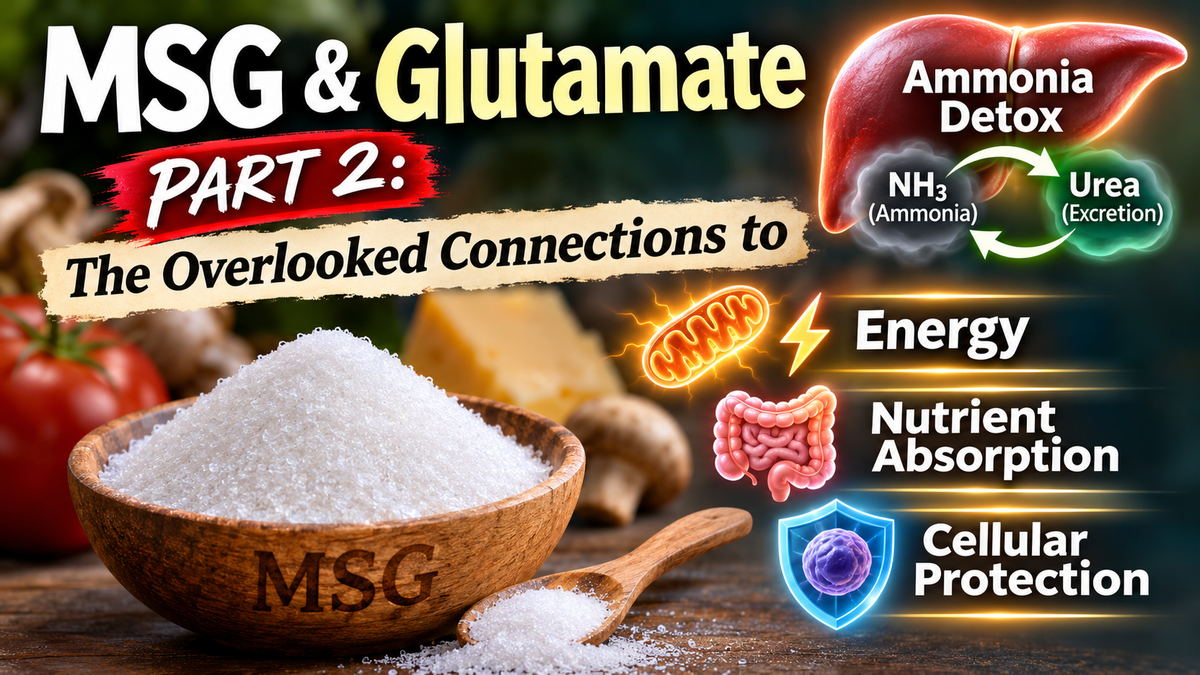
That is exactly where we’re heading in Part 2.
What Kelsey’s Experience Taught Me
Kelsey had already made significant progress with her copper toxicity through dietary changes and flush niacin, including major improvements in her EMF sensitivity.
However, her copper and zinc levels still needed work, and she wasn’t tolerating higher doses of zinc very well.
Determined to find a better way to support copper detoxification, she started digging into glutamate research.
What she found convinced her to experiment with MSG.
Her initial dose was a bit too enthusiastic—approximately 4 grams in one day—which caused some temporary neck cramping.
But something interesting happened.
Her prolonged menstrual bleeding stopped the very next morning.
Over the following months, she reported more regular periods, improved mood and energy, better body composition, and noticeable improvements in ADHD-type symptoms.
And that got MY attention.
Kelsey wasn’t just finding interesting research. She was seeing the benefits firsthand.
Then other people started trying MSG, and the testimonials began rolling in.
The Testimonials Started Coming In
One member reported:
“My workouts have been a little better, mood has been calmer and sleep a little deeper”
Another member described years of difficulty lowering his serum copper.
After beginning MSG, he reported that his copper measurements finally started to decline.
He also described improvements in sleep, energy, concentration, and even in the appearance of a longtime toe issue.
Another member reported improved mental acuity, greater ability to focus on complicated tasks, more vivid dream recall, and disappearance of a low-level rash.
Another person reported improved memory, mental energy, and sleep efficiency while using approximately 500 mg of MSG.
And these were only some of the experiences we were hearing.
People were describing changes involving:
-
Sleep and nighttime awakenings.
-
Copper and zinc-related measurements.
-
Zinc supplement tolerance.
-
Mood and concentration.
-
Food cravings.
-
Body composition.
-
Exercise performance.
-
Skin symptoms.
-
Menstrual bleeding and PMS.
Some of those reports were particularly dramatic.
We’ll examine the testimonials and mineral-related research in much greater detail in Part 3.
But the important point here is that the lived experiences were going in a very different direction from the MSG horror stories.
That made us want to understand the underlying biochemistry.
And the deeper we investigated, the more interesting glutamate became.
More MSG Research, Questions & Real-World Experiences
After our original MSG livestream, the questions and testimonials kept coming. In this follow-up episode, I examine additional research on glutamate, ferritin, liver detoxification, sleep, food cravings, and the changes people have been reporting.

MSG Is NOT an Excuse to Eat Junk Food
Before wrapping up this first article, I want to make one thing VERY clear.
When I talk about MSG, I’m talking about pure monosodium glutamate added to otherwise appropriate food.
I’m not saying that processed junk foods become healthy because they contain MSG.
I’m not telling people to start consuming large amounts of added fats.
I’m not saying to abandon a low-”vitamin” A or low-copper diet.
And I’m certainly not saying that cheese becomes a health food because it contains glutamate.
Be smarter than that.
One of the things I’ve found most interesting is that MSG may help people enjoy relatively simple foods more.
Meat.
Rice.
Other foods that fit their individual dietary needs, etc.
It really helps the “boring” foods be LESS BORING.
MSG improves the savory flavor of those foods.
And if that makes it easier for someone to avoid foods they’re trying to eliminate, that’s another benefit worth considering.
Pure MSG Is Very Inexpensive
MSG is not some expensive proprietary supplement.
It has been commercially available for more than a century.
Aji-no-moto is the original brand associated with its commercialization.
And people can purchase plain MSG powder without spending enormous amounts of money.
That’s another thing I like about this investigation.
We’re not talking about some $100-per-bottle supplement with a fancy marketing campaign.
We’re talking about a simple amino acid salt.
One that the body already recognizes and metabolizes.
A Little May Go a Long Way
One of the lessons from our early experiments was that people often didn’t need enormous amounts.
Some reported changes from small pinches added to food.
Others experimented with larger amounts.
The experiences of Kelsey and several members taught us that individual tolerance and response could vary considerably.
One person who initially experienced a headache later reported improved sleep and better tolerance of Keystone Minerals.
Another person found that approximately 500 mg a day suited them.
The point is that there is no reason to equate the dramatic quantities used in certain experimental feeding studies with what someone would ordinarily use as a seasoning.
Ordinary food use is an entirely different context.
And since MSG contains approximately 12% sodium by weight, compared with approximately 39% for table salt, it can also provide savory flavor with considerably less sodium per gram.
You will be able to use less salt when you simultaneously use MSG.
In Part 3, we’ll cover more of the practical experiences, including how members have been using MSG with meals.
The Larger Pattern: Glutamate Is a Fundamental Part of Human Metabolism
Let’s bring everything together.
We’ve covered a lot of research.
And I want you to notice how the findings connect.
MSG has been used commercially since 1909.
The famous “Chinese Restaurant Syndrome” narrative appeared nearly 60 years later.
The classic brain damage experiments involved injecting MSG into newborn animals.
When researchers fed enormous amounts of MSG to animals, they did not observe the same brain lesions.
Your intestines extensively metabolize dietary glutamate.
Your intestinal cells use glutamate for energy.
Your body has specialized taste systems that recognize glutamate.
Your digestive system responds to dietary glutamate.
The blood-brain barrier regulates glutamate movement into the central nervous system.
Human breast milk naturally contains large amounts of free glutamate.
Researchers have investigated glutamate and glutamine in human milk for their potential roles in protecting developing infants.
Experiments involving enormous oral glutamate intakes did not produce the dramatic neurological effects people might expect from the excitotoxin narrative.
Regular MSG users did not demonstrate accumulation of fasting plasma glutamate.
Blinded human studies repeatedly failed to reproduce the supposedly characteristic MSG reactions.
And a randomized human trial found that prolonged MSG exposure REDUCED desire for savory foods.
That’s a LOT of evidence pointing in a very different direction from the popular MSG scare.
And we’re not even into the most interesting liver-related research yet.
The Bottom Line: We’ve Been Grossly Misled About MSG
I don’t know how many people have spent years avoiding MSG because somebody convinced them it would damage their brain.
Probably millions.
People have been afraid of an amino acid that their intestines actively use for energy.
An amino acid that their bodies manufacture through numerous pathways.
An amino acid that is naturally abundant in human breast milk.
An amino acid that is deeply involved in nitrogen and energy metabolism.
And the primary scare story came from experiments involving injected MSG in newborn animals.
Injected into newborn animals.
Not sprinkled onto food.
That distinction should have been front and center in the discussion from the beginning.
Instead, people were left with decades of fear.
Meanwhile, studies involving enormous dietary intakes, long-term MSG users, and blinded human challenges produced findings that were far less frightening.
And now we’re hearing from people who are reporting improvements after introducing small amounts of MSG into their diets.
Better sleep.
Improved supplement tolerance.
Reduced food cravings.
Changes in copper-related blood tests.
Better energy and concentration.
Improvements in body composition.
Those observations are why Kelsey and I began investigating this so seriously.
But they’re only part of the story.
Because when you begin looking at the actual biochemistry, glutamate shows up in some VERY interesting places.
Glutathione.
Liver enzymes.
Bile metabolism.
Ammonia handling.
Aldehyde dehydrogenase.
Cellular energy production.
And even some of the transport systems involved in moving unwanted substances out of cells.
That’s where the implications become much bigger than whether MSG causes a headache.
I think glutamate may be one of the most overlooked pieces of the liver detoxification puzzle.
And in Part 2, we’re going to examine exactly why.
Because your body doesn’t simply tolerate glutamate.
It MAKES glutamate. It USES glutamate. And it actively RECYCLES glutamate.
Maybe it’s time we stopped treating this essential amino acid like the enemy.
Enjoy your food more while you’re at it too! Listen to Uncle Roger, MSG’s biggest fan on YouTube:


Written by Garrett Smith