Nickel in Your Water: Pipes, Plumbing, Faucets, Wells, and the Exposures You Drink
There is a very simple assumption most of us make about drinking water:
The water coming out of the faucet is basically the same water the utility tested.
Yeah...Not. At. All.
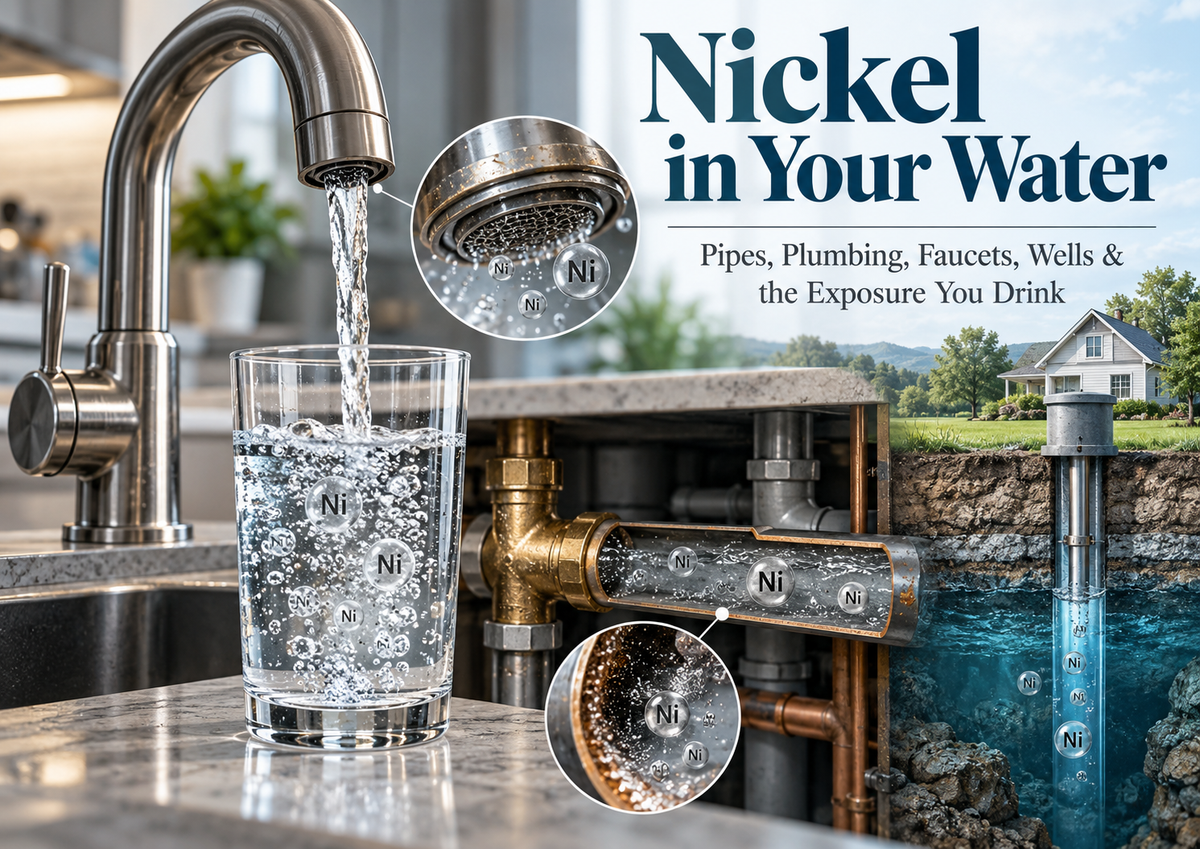
This nickel rabbit hole gets weird because the water can leave the municipal treatment plant with relatively little nickel in it, travel through the distribution system, enter your house—and then pick up nickel inside your own plumbing before you drink it.
Your faucet can be the contamination source.
Your fittings can be the contamination source.
Your stainless-steel plumbing can be the contamination source.
If you’re on a private well, even the MATERIALS USED TO BUILD THE WELL can be the contamination source.
And then there’s another twist that makes water different from food.
The nickel you drink in plain water, particularly on an empty stomach, can be MUCH more bioavailable than the nickel you eat in food.
That one got my attention.
Water Nickel Is NOT the Same as Food Nickel
In the previous food article, I went through just how much dietary nickel can vary and how certain foods can absolutely dominate somebody’s nickel intake.
But total nickel going into your mouth is only part of the story.
How much gets absorbed is another critical piece.
There is an old human study that I keep coming back to because the difference is ridiculous.
Researchers gave healthy volunteers nickel sulfate either dissolved in drinking water or mixed into scrambled eggs. The volunteers were fasted beforehand.
Average nickel absorption from the water:
27 ± 17%.
Average absorption when the same nickel dose was put into food:
0.7 ± 0.4%.
That’s roughly a 40-fold difference.
The researchers’ conclusion was pretty straightforward:
“approximately one-quarter of nickel ingested in drinking water after an over-night fast is absorbed”
Compare that with:
“only 1% of nickel ingested in food.”
Nickel absorption and kinetics in human volunteers
SERIOUSLY?!?!
This is why simply comparing the number of micrograms of nickel in your food against the number of micrograms in your water can be misleading.
You may ingest MORE total nickel from food.
But plain drinking water—especially on an empty stomach—can deliver a much larger fraction of that nickel into the body.
Another human study drove this point home.
When nickel-containing water was given 30 minutes or one hour BEFORE scrambled eggs, the peak serum nickel concentration was 13 times higher than when the nickel-containing water and the food were consumed simultaneously.
“the peak was 13-fold higher”
Think about when many people drink the most plain water. Also, what do many health goo-roo influencers tell people to do right after waking, over and over?
Drink a big glass of plain water, first thing in the morning, before eating any food, after not eating all night.
The ABSOLUTE WORST possible timing if that water happens to contain a significant amount of nickel.
Whatever amount of nickel is actually in that water, it will be absorbed 40x more than it would be from food, so any nickel in that water becomes significant VERY quickly.
Where will the highest-nickel water in the house be sitting first thing in the morning?
Inside the faucet and plumbing where it has been sitting ALL NIGHT.
Now the pieces start fitting together.
The Water Utility May NOT Be Your Biggest Problem
The newest WHO drinking-water guidance makes an important distinction that tends to get lost when people talk about “nickel in water.”
WHO states that food is usually the dominant nickel exposure source in people who aren’t occupationally exposed or smokers.
Fair enough.
But then they say this:
“The primary source of nickel in drinking-water is leaching from metals that are in contact with drinking-water.”
That’s a completely different problem.
WHO 2026 chemical fact sheet for nickel in drinking water
Read that again.
The PRIMARY source of nickel in drinking water can be the metal touching the water.
Not necessarily the reservoir.
Not necessarily the aquifer.
Not necessarily industrial pollution upstream.
Your plumbing.
WHO specifically calls out nickel- or chromium-plated taps, stainless-steel devices, fittings, and other materials contacting the water. They also note that while drinking-water nickel is typically below 25 µg/L, levels can rise as high as 5 mg/L—5,000 µg/L—under certain conditions involving alloys, contamination, or natural deposits.
So if somebody tells you:
“My city’s water report says nickel is low, so my tap water has low nickel.”
My next question is:
Where was the sample collected?
Because that matters.
A sample taken at the treatment plant is not necessarily telling you what’s coming out of the faucet in your kitchen at 6:30 tomorrow morning.
The First Water Out of the Faucet is the WORST Water
One of the more fascinating papers on this is from 1983.
Researchers measured nickel in tap water around Copenhagen.
The first 250 mL coming from some taps contained nickel concentrations as high as approximately:
490 µg/L.
Then they flushed the taps for five minutes.
Nickel dropped to acceptably low levels after that.
They also found:
“Hot water gave higher values than cold water.”
And:
“Considerable variation from time to time and from tap to tap was found.”
This is exactly the type of result that makes a SINGLE random tap-water measurement potentially misleading.
Which tap?
How long had the water been sitting?
Was it the first draw?
Cold or hot?
How old was the faucet?
How much water had already passed through?
Those aren’t little details.
They may determine whether you’re measuring 5 µg/L or 100+ µg/L.
A much more recent field study looked at 110 household faucets.
In the first 100 mL of water, 20% of the faucets exceeded the European standard of 20 µg/L of nickel.
After approximately 5 liters had been flushed through the faucets, the fully flushed water met the standard.
The investigators wrote:
“It is important to flush retained water out of the tap after several hours without use.”
A field survey on elution of lead and nickel from taps used in homes
THAT is useful.
Because now we aren’t just talking theory.
We have actual household faucets where the first bit of water sitting inside them contains substantially more nickel than the water after flushing.
Stagnation Is a Big Deal
Water is a solvent.
Leave it touching metal long enough and things can move from that metal into the water.
It’s called leaching, and don’t let anyone on the internet tell you it’s too little to make any difference.
That’s why the amount of time water sits inside plumbing matters.
WHO specifically states:
“Nickel leaching is particularly influenced by stagnation time.”
And their practical recommendation is very simple:
“Consumers, particularly nickel-sensitive people, should flush nickel- or chromium-plated taps before using the water, particularly after periods of stagnation.”
WHO drinking-water treatment guidance — Nickel
“Periods of stagnation” means things like:
-
first thing in the morning;
-
coming home after work;
-
a faucet nobody has used all day;
-
returning after a weekend away;
-
coming home after vacation;
-
a guest bathroom that’s rarely used.
This is one reason I don’t like people obsessing over complicated detox protocols while ignoring obvious ongoing exposure.
If the water sitting in your faucet overnight is picking up nickel, DON’T DRINK THE FIRST WATER OUT OF THE TAP.
You don’t need a $5,000 supplement protocol to accomplish that.
Turn on the faucet.
Use COLD water.
Let the stagnant water clear.
The old Copenhagen study found low nickel after five minutes of flushing, but I don’t think everybody needs to blindly stand there running the water for five minutes every single morning. Plumbing systems vary enormously.
The more useful practical sign is to run the cold water until it becomes noticeably colder and the temperature stabilizes, indicating that you’ve moved beyond much of the water that was sitting in the immediate fixture and nearby plumbing.
After a longer period of non-use, I would flush longer.
This is simple exposure reduction.
And Stop Drinking Hot Tap Water
The 1983 study didn’t merely find nickel in tap water.
They specifically found that:
“Hot water gave higher values than cold water.”
Heat generally makes water more aggressive toward plumbing materials and increases many corrosion and leaching processes.
So here’s an easy rule:
Do not use hot water directly from the faucet for drinking or cooking.
Want hot water?
Take COLD water and heat it yourself.
Don’t fill the pasta pot from the hot tap because it gets you boiling water three minutes faster.
Don’t make coffee with water from the hot side.
Don’t make tea with it.
DEFINITELY don’t ever use one of those instant hot water dispensers. They have a stainless steel tank that is constantly keeping the water inside close to boiling. That is a recipe for disaster (time plus heat).
This advice isn’t even nickel-specific. It’s generally a smarter way to minimize metals coming from household plumbing.
Your Faucet May Matter More Than Your Pipes
When people hear “metal contamination from plumbing,” they usually picture miles of pipe.
But faucets and fittings can be surprisingly important because several different metals and surface coatings may be packed into a very small area.
WHO notes that nickel can come from:
-
chromium-plated taps;
-
nickel-plated materials;
-
stainless-steel piping;
-
stainless-steel fittings;
-
other metal alloys contacting drinking water.
And remember what the household faucet study found:
The nickel concentration gradually declined as successive 100 mL portions came out of the faucet.
That pattern screams local fixture contribution.
If the municipal water itself were equally contaminated throughout the system, flushing the faucet wouldn’t magically fix it.
The water touching the faucet was picking something up.
That’s important because it means there are really TWO separate questions:
1. How much nickel enters your house?
And:
2. How much nickel gets added INSIDE your house?
These are different AND additive issues.
Drinking-Water Nickel Standards Are All Over the Place
Here’s where things get even more interesting.
WHO: 70 µg/L
The current 2026 WHO Guidelines retain a nickel guideline value of:
0.07 mg/L = 70 µg/L = 70 ppb.
WHO Guidelines for Drinking-water Quality, 2026 edition
How did they come up with this number? The answer is a bit shady.
I pasted the entire abstract from Urgent need to reevaluate the latest World Health Organization guidelines for toxic inorganic substances in drinking water below, so you can judge for yourself if the WHO’s guideline has been tainted by industry interests/money:
The World Health Organization (WHO) has established guidelines for drinking-water quality that cover biological and chemical hazards from both natural and anthropogenic sources. In the most recent edition of Guidelines for Drinking-water Quality (2011), the WHO withdrew, suspended, did not establish, or raised guidelines for the inorganic toxic substances manganese, molybdenum, nitrite, aluminum, boron, nickel, uranium, mercury, and selenium. In this paper, we review these changes to the WHO drinking-water guidelines, examining in detail the material presented in the WHO background documents for each of these toxic substances. In some cases, these WHO background documents use literature reviews that do not take into account scientific research published within the last 10 or more years. In addition, there are instances in which standard WHO practices for deriving guidelines are not used; for example, rounding and other mathematical errors are made. According to published meeting reports from the WHO Chemical Aspects Working Group, the WHO has a timetable for revising some of its guidelines for drinking-water quality, but for many of these toxic substances the planned changes are minimal or will be delayed for as long as 5 years. Given the limited nature of the planned WHO revisions to the inorganic toxic substances and the extended timetable for these revisions, we suggest that governments, researchers, and other stakeholders might establish independent recommendations for inorganic toxic substances and possibly other chemicals to proactively protect public health, or at the very least, revert to previous editions of the Guidelines for Drinking-water Quality, which were more protective of public health.
That whole thing stinks to high heaven as protecting INDUSTRY and having NOTHING to do with protecting HEALTH.
European Union: 20 µg/L
The European Union’s Drinking Water Directive uses:
20 µg/L.
Not 70.
Twenty.
EU Drinking Water Directive — nickel parametric value
California Public Health Goal: 12 µg/L
California’s Office of Environmental Health Hazard Assessment developed a Public Health Goal of:
12 µg/L.
Their document states:
“A public health goal (PHG) of 0.012 mg/L (12 µg/L or 12 ppb) is developed”
California Public Health Goal for Nickel in Drinking Water
California’s actual current enforceable state Maximum Contaminant Level is MUCH higher, at 0.1 mg/L, or 100 µg/L.
Remember: a Public Health Goal is NOT the same thing as a legally enforceable standard. California explicitly describes PHGs as health-based goals rather than regulatory limits.
A perfect example of how talk is cheap, and actions always speak louder than words.
United States federal limit: THERE ISN’T ONE
This is the part a lot of people don’t know.
The U.S. EPA established an MCL and MCLG of 0.1 mg/L for nickel in the early 1990s.
Then they were challenged.
EPA and nickel-industry petitioners jointly sought remand (to send or order something back), and the nickel MCL and MCLG were vacated.
Do you think it was the exact same industries that infected the WHO’s decision above? I sure do.
EPA’s archived technical information states:
“there is currently no EPA legal limit on the amount of nickel in drinking water.”
EPA Technical Fact Sheet on Nickel
So today we have:
California health goal: 12 µg/L
European Union limit: 20 µg/L
WHO guideline: 70 µg/L
U.S. federal enforceable MCL: NONE. ZIP. ZILCH. NADA.
That’s quite a spread for one metal.

This episode goes deeper into the very different nickel limits used by WHO, Europe, California, and U.S. regulators, along with the larger water-exposure problem.
Private Wells Are a Completely Different Animal
If you’re on city water, somebody is at least testing the source water and the distribution system for a long list of contaminants.
A private well?
Now YOU are the water department.
And nickel can enter well water through at least two very different pathways.
Nickel can already be in the groundwater
Nickel occurs naturally in soil and rock.
Groundwater concentrations can vary with geology, pollution, land use, depth, and water chemistry.
WHO notes that unusually high drinking-water nickel can occur where natural nickel deposits are mobilized or where groundwater is contaminated.
Acidic or otherwise chemically aggressive groundwater can make some metals more mobile.
But here’s the part that I find fascinating.
The WELL ITSELF can add nickel
Researchers investigating wells at Williams Air Force Base in Arizona found elevated nickel and chromium concentrations that initially looked like groundwater contamination.
Then they investigated the construction of the wells.
The source?
Type 304 stainless-steel well components.
The authors concluded that chloride in the groundwater had apparently caused crevice corrosion of the stainless-steel well screens.
Nickel and Chromium in Ground Water Samples as Influenced by Well Construction and Sampling Methods
WHO’s review of this work reports average nickel concentrations associated with these well materials ranging from approximately 8 to 395 µg/L, with some cases reaching 1–5 mg/L (1000 to 5000 µg/L)!!!
Yes.
Milligrams. As in thousands of micrograms.
Again, imagine testing “groundwater” and assuming everything detected came out of the ground.
Sometimes even your SAMPLE COLLECTION HARDWARE is contaminating the sample.
Nickel is such a trickster metal.
A Real-World Example: Higher Nickel in the Water, Higher Nickel in the Blood
There’s also human evidence showing that environmental water exposure can show up in the body.
Researchers compared healthy hospital workers living in Sudbury, Ontario—an area with extensive nickel mining and smelting—with workers in Hartford, Connecticut.
Sudbury tap water:
109 ± 46 µg/L nickel
Hartford tap water:
roughly 0.4–0.6 µg/L
Serum nickel in the healthy Sudbury workers:
0.6 ± 0.3 µg/L
Serum nickel in Hartford:
0.2 ± 0.2 µg/L
Serum nickel concentrations in hemodialysis patients with environmental exposure
People living where the tap water contained MUCH more nickel also had significantly higher serum nickel.
That is not something I would just shrug off.
The Electric Kettle Rabbit Hole
I wasn’t originally expecting electric kettles to become part of the water story.
Of course they did.
Researchers tested electric kettles for release of nickel, chromium, and lead under conditions intended to simulate household use.
Out of 26 kettles, TEN released more than 50 µg/L of nickel into the water.
“Ten out of 26 kettles sold on the Danish market released more than 50 μg/l nickel”
The release of nickel and other trace elements from electric kettles and coffee machines
WHO’s earlier review described reports of 100–400 µg/L from electric kettles, with extreme values above 1,000 µg/L, particularly when involving nickel-plated heating elements.
So you could theoretically start with relatively clean water and ADD nickel by boiling it.
Wonderful.
This does overlap with the stainless-steel/cookware rabbit hole, and I’m deliberately not going to burn through all of that here because that’s getting its own article.
But if you’re trying to identify nickel exposure, don’t forget:
Whatever touches the water AFTER filtration still matters.
Your kettle.
Your coffee machine.
Your storage container.
Your faucet.
Your plumbing.
Your water bottle.
The filter housing itself.
We’ll go much deeper into stainless steels and cookware separately.
How I Would Actually Test This
If you’re seriously trying to figure out whether water is a meaningful nickel source for you, I would NOT be satisfied with one generic city report.
I’d want to know what’s actually coming out of YOUR faucet.
And ideally, I would compare different conditions.
Sample #1: first draw
Collect water first thing in the morning BEFORE flushing.
This helps answer:
What am I exposed to if I drink or bathe in the stagnant overnight water?
Sample #2: fully flushed cold water
Run the COLD water until it is clearly colder and has stabilized, then collect another sample.
This helps distinguish:
Source-water nickel versus plumbing/faucet nickel.
If the first-draw sample is high and the flushed sample falls dramatically, start looking hard at plumbing and fixtures.
If BOTH stay high, now the source water, service line, well, or more distant plumbing becomes more suspicious.
If you’re on a private well
I would test it.
Period.
And if the number is bizarrely high, do not automatically assume Mother Earth put all that nickel in the groundwater.
Ask what the well casing, screen, pump, fittings, pressure system, and sampling hardware are made from.
We have actual published evidence showing that stainless well components themselves can create misleadingly high nickel measurements.
Water Chemistry Matters Too
Corrosion isn’t controlled by one variable.
Water chemistry matters.
pH matters.
Chloride matters.
Alkalinity matters.
Dissolved gases matter.
Temperature matters.
Residence time matters.
The alloy matters.
The condition of its surface matters.
WHO specifically notes evidence that corrosion-control measures such as pH control may reduce nickel leaching from stainless-steel materials.
The Arizona well case showed chloride-associated crevice corrosion of Type 304 stainless steel.
So two houses with the EXACT SAME faucet could potentially release different amounts of nickel depending upon the water running through them.
The actual exposure depends upon the whole system.
Test the water.
What About Reverse Osmosis and Water Filters?
This is where marketing can get ahead of the evidence VERY quickly.
Companies will say:
“Removes heavy metals!”
Okay.
Which metals?
How much?
At what starting concentration?
Under what test standard?
At what point in the filter’s life?
Nickel is a dissolved metal ion, and membrane treatment, ion exchange, adsorption, and other technologies CAN reduce nickel.
Reverse osmosis is an excellent general point-of-use strategy for reducing dissolved solids and many inorganic contaminants.
This solves the drinking water question pretty quickly.
Distillation
Distillation should leave nonvolatile dissolved nickel behind when water is properly distilled.
My one caveat is hardware.
I still want to know what the distilled water contacts afterward.
The cooling pipes on most home water distillers are stainless steel and are exposed to steam and near-boiling/boiling water temperatures before cooling down. It’s literally how they work.
Remember: clean water can pick metals back up from downstream materials.
This nickel problem keeps turning into the same lesson.
The LAST thing touching your water matters.
My Practical Nickel-in-Water Checklist
This does not need to become complicated.
If I were trying to reduce nickel from water, here’s where I would start:
-
Find out what is actually in your water. Look up your utility’s Consumer Confidence Report, state data, and local groundwater information—but don’t assume that tells you what your faucet adds.
-
If you’re on a private well, TEST IT. Especially if you’re already dealing with a nickel problem.
-
Compare first-draw versus flushed water if you suspect plumbing contamination.
-
Flush stagnant water before drinking it. Especially first thing in the morning or after the faucet has sat unused for hours.
-
Use COLD tap water for drinking and cooking. Heat it afterward.
-
Pay attention to faucets and fittings, not just pipes.
-
Investigate well hardware if a private-well nickel result is surprisingly high.
-
Don’t forget kettles, coffee makers and downstream containers.
-
If using filtration specifically for nickel, verify nickel performance rather than trusting generic “heavy metal” marketing.
-
When the answer really matters, test before and after filtration.
We like WaterCheck.com as one source for comprehensive water testing (no financial affiliation).
It’s not glamorous.
It doesn’t sell some exotic “nickel detox stack.”
I care a LOT more about stopping the exposure first.
The Part About Water That Changes the Nickel Equation
The biggest thing I want people to understand from this article is NOT that everybody’s drinking water is loaded with nickel.
The point is that water can become a highly variable, highly local, surprisingly bioavailable exposure.
And the number coming out of YOUR faucet can be very different from what somebody measured somewhere else in the water system.
We have human research showing approximately 27% absorption from fasted nickel-containing water versus less than 1% from the same dose in food.
We have taps producing nearly 500 µg/L in first-draw water.
We have modern household data showing one in five faucets tested exceeded 20 µg/L in the first 100 mL.
We have stainless-steel well equipment creating nickel concentrations reaching the MILLIGRAMS per liter range.
We have electric kettles adding nickel to water.
We have WHO explicitly stating that the primary source of nickel in drinking water can be the metals in contact with the water.
Put all of those findings next to each other.
THAT is the story.
Food may provide more total nickel for most people.
However, the glass of water you drink first thing in the morning can be a completely different exposure scenario—particularly if that water spent eight hours sitting against nickel-containing plumbing and then goes into an empty stomach.
So yes, pay attention to food.
But don’t painstakingly remove the oats, chocolate, nuts, seeds, beans, soy, and everything else from your diet while gulping down the first stagnant water out of a nickel-leaching faucet every morning.
That would be...less than ideal. 😎
And this leads perfectly into the next part of the nickel exposure rabbit hole: what we’re breathing. Industrial emissions, smoke, dust, wildfires, occupational exposure—and why inhaled nickel deserves to be treated VERY differently from nickel swallowed in food.
That’s where we’re going next.

Written by Garrett Smith