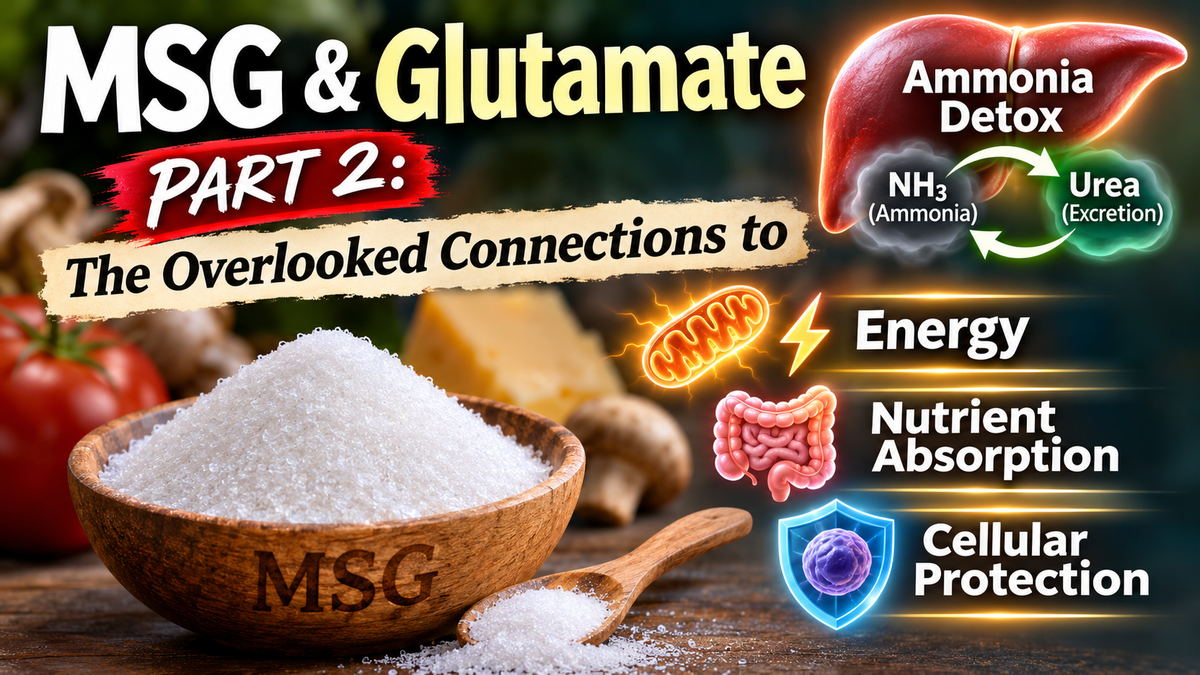
MSG & Glutamate PART 2: The Overlooked Connections to Ammonia Detox, Energy, Nutrient Absorption & Cellular Protection
What if adding a specific (and inexpensive) seasoning to your food could help your body get EVEN MORE out of the protein you’re already eating?
What if it could help your body process toxic ammonia, produce energy, and even support some of the systems responsible for moving unwanted substances out of your cells?

What if there were actual HUMAN studies demonstrating these effects?
What is this powerful substance I’m talking about?
It’s monosodium glutamate.
MSG.
Yes, the same stuff people have been told to avoid for decades.
In Part 1 of this series, I introduced our investigation into MSG and glutamate.
Now we’re going to explore some additional research that Kelsey Kenney, our main health consultant/facilitator, and I found particularly interesting.
Because the more we investigated glutamate, the more we kept finding connections to problems I’ve been discussing for YEARS.
Poor energy.
Difficulty handling ammonia.
Problems with digestion.
Nutrient absorption.
Copper toxicity.
Zinc deficiency.
The body’s ability to get unwanted substances OUT of its cells.
These problems may seem unrelated.
However, the truth is that ALL of the body’s systems are interconnected.
Glutamate is involved in several very important connections.
Let’s look at what the research actually shows.
Your Liver Enzymes ALT, AST, and GGT Literally MAKE Glutamate!
Here’s something I bet most people, even physicians, have never heard about.
You know those liver enzymes that get measured on your blood tests?
ALT, AST, and GGT?
What if I told you that ALL THREE are involved in biochemical reactions that produce or release GLUTAMATE?
Yes, GLUTAMATE.
The same substance that people have been told to fear because of MSG.
Let’s look at what these enzymes actually DO.
ALT: Alanine Aminotransferase
ALT is one of the most commonly measured liver enzymes.
Most people have no idea what its actual job is.
ALT can take an amino group from alanine, an amino acid, and transfer it to a substance called alpha-ketoglutarate.
What does that produce?
GLUTAMATE!
The reaction looks like this:
Alanine + alpha-ketoglutarate ⇌ pyruvate + GLUTAMATE
In other words, ALT MAKES glutamate.
It’s not some unusual side reaction.
Let’s keep going.
AST: Aspartate Aminotransferase
Now let’s look at AST.
Another enzyme routinely measured on liver blood tests.
AST performs a similar reaction, except it uses a different amino acid called aspartate.
The reaction is:
Aspartate + alpha-ketoglutarate ⇌ oxaloacetate + GLUTAMATE
There it is AGAIN.
AST MAKES glutamate, too!
Both reactions are reversible, meaning these enzymes can also use glutamate to run the reactions in the opposite direction.
The important point is that glutamate is a direct product of reactions performed by BOTH enzymes.
Now look at this.
GGT: Gamma-Glutamyl Transferase
GGT is another enzyme commonly included in liver testing.
Its connection to glutamate is particularly interesting.
GGT helps break down glutathione and other compounds containing a gamma-glutamyl group.
Remember, glutathione is made from three amino acids:
Glutamate + cysteine + glycine.
NOT glutamINE, but glutamATE.
When glutathione is processed through the GGT pathway, its glutamate-containing portion can eventually be released as free glutamate.
So GGT participates in a system that helps RECOVER glutamate from glutathione.
This is especially interesting because of research examining what happens inside the bile ducts.
A 1986 study was titled Intrabiliary Glutathione Hydrolysis: A Source of Glutamate in Bile.
The researchers found that glutathione breakdown within the biliary system was responsible for producing much of the free glutamate found in bile.
They concluded that:
“most, if not all, of the free glutamate in excreted bile”
came from glutathione breakdown.
Think about that.
Your liver secretes glutathione into bile.
Enzymes involved in glutathione breakdown help release glutamate.
Then the biliary system has mechanisms capable of taking that glutamate back up!
A separate study, Glutamate Uptake in Primary Cultures of Biliary Epithelial Cells from Normal Rat Liver, identified specialized glutamate uptake systems in bile duct cells.
In other words, the body isn’t simply throwing all that glutamate away.
It’s equipped to RECYCLE & RECOVER it.
Must be pretty important stuff, yeah?!?!
Three Liver Enzymes. Three Connections to Glutamate.
Let’s put this together.
ALT produces glutamate from alanine.
AST produces glutamate from aspartate.
GGT participates in breaking down glutathione, allowing its glutamate component to be recycled & recovered.
Three enzymes routinely measured when evaluating liver health.
ALL THREE connected to glutamate metabolism.
Your liver desperately needs and wants glutamate so bad it MAKES IT, yet people have been taught to fear MSG because of the glutamate?
Your own liver is involved in producing, processing, and recycling glutamate every single day.
Here’s a very important question to consider:
What if supplying a “stressed” liver that is desperately trying to MAKE more glutamate (evidenced by increased AST, ALT, and/or GGT) with dietary glutamate (one easy source is MSG), takes stress OFF the liver and allows it to put energy elsewhere?
The Western world has been psy-opped into an irrational fear of MSG and glutamate, and we have some of the highest liver disease rates in the world.
Coincidence?
Your Body Uses Glutamate to Help Process Protein
When people think about protein, they usually think about building muscle.
Eat protein.
Build muscle.
Simple enough, right?
Well, not exactly.
Before your body can use protein, it has to digest it into smaller pieces, including individual amino acids.
Those amino acids can then be used to build and repair tissues, manufacture important compounds, or produce energy.
Something else happens though.
Your body can convert one amino acid into another.
Glutamate is absolutely one of the most important substances involved in those conversions.
Many Different Amino Acids Can Be Used to Make Glutamate
Your body can manufacture glutamate from numerous amino acids.
Some of these include:
-
Alanine
-
Aspartate
-
Glutamine
-
Proline
-
Histidine
-
Leucine
-
Isoleucine
-
Valine
There are other pathways as well.
Why does this matter?
Because your body has multiple ways to produce glutamate from the protein you eat.
Glutamate haters should be left wondering, if it’s so bad, why does our body have so many different ways to make it?
Glutamate also helps your body move nitrogen between different compounds.
Nitrogen is a major component of amino acids.
When the body breaks down or rearranges amino acids, that nitrogen has to be handled properly.
Glutamate is one of the main substances involved in that process.
Think of glutamate as a busy intersection where many different amino acid pathways meet.
One of the most important destinations involves ammonia.
Glutamate Helps Your Body Deal With Toxic Ammonia
Ammonia is something I’ve become increasingly interested in.
Your body produces ammonia naturally.
It comes from breaking down protein and other nitrogen-containing substances.
Bacteria in your intestines can also produce ammonia.
Ammonia becomes highly toxic when too much accumulates.
Excessive ammonia affects the brain, nervous system, and other tissues.
That’s why the liver has systems specifically designed to manage it.
Here’s where glutamate comes in.
Your Body Can Combine Glutamate With Ammonia
There’s an enzyme called glutamine synthetase.
Don’t worry about remembering the name.
What matters is what it DOES.
This enzyme helps combine glutamate with ammonia to make another amino acid called glutamine.
In plain English:
Glutamate + ammonia → glutamine
The process requires energy, and the concept is straightforward.
Ammonia becomes incorporated into glutamine, which can then carry nitrogen to other parts of the body for further processing.
That’s one of the ways your body handles ammonia.
Now here’s where the research gets interesting.
One Study Found This System Handled About ONE-THIRD of Ammonia
A 2017 study titled Pivotal Role of Glutamine Synthetase in Ammonia Detoxification investigated how the liver handles ammonia.
The researchers studied two important systems.
One was the urea cycle, which helps convert ammonia into urea so the body can eliminate nitrogen through urine.
The other was the glutamine synthetase system we just discussed.
What did they find?
In their mouse experiments, approximately:
-
35% of ammonia was handled by the glutamine synthetase system.
-
35% was handled through the urea cycle.
-
30% escaped removal by the liver under those experimental conditions.
Read that again.
About ONE-THIRD of the ammonia was handled through a system that requires GLUTAMATE.
That’s an important amount, and it demonstrates just how significant this pathway can be.
Another Study Found That Increasing This Enzyme Improved Ammonia Removal
In 2019, researchers published Hepatic Glutamine Synthetase Augmentation Enhances Ammonia Detoxification.
They investigated what happened when they increased the activity of glutamine synthetase in the liver.
The results?
The animals were better able to handle ammonia.
Blood ammonia decreased following an ammonia challenge.
The researchers concluded that increasing this enzyme’s activity improved ammonia detoxification in their experimental models.
Now think about this.
We have one study demonstrating that glutamine synthetase handles a substantial portion of ammonia.
Then we have another demonstrating that increasing this system’s activity improves ammonia removal.
This system requires glutamate to perform its job.
That’s a rather interesting connection for something we’ve been told is so bad for us, isn’t it?
Why Glutamate and Glutamine Are NOT the Same Thing
People often confuse glutamate with glutamine.
Their names are similar.
The body can convert one into the other.
They have different roles though.
Glutamate can combine with ammonia to form glutamine.
Glutamine can also be broken down, releasing ammonia.
So simply taking more glutamine isn’t the same thing as providing glutamate.
Taking more glutamINE is effectively adding more downstream AMMONIA to the system.
This distinction matters when we’re talking about ammonia metabolism.
Now understand this.
The alternative health goo-roos telling you to take MASSIVE doses of glutamINE are literally having you take in MORE AMMONIA (toxic) in their indirect advice to have you consume MORE GLUTAMATE (which would be helpful).
That’s why the mega-dosing glutamine protocols never helped as much as people hoped. It’s also why everyone quits it at some point (the fad keeps coming back though, like so many ineffective things in the nutritional supplement world!).
So, in simple terms:
-
Taking glutamINE brings in glutamATE (good) and ammonia (bad)
-
Taking glutamATE means it can be used for all the things the body needs glutamate for, AND it can be used to scavenge toxic ammonia (which your body will make anyway)
One of these is much preferable to the other!
Glutamate Can Also Be Used to Make ENERGY
Now let’s talk about something almost everybody wants more of.
ENERGY.
Your cells require energy to function.
They need it to move substances around, repair tissues, contract muscles, and perform countless other jobs.
Most people have heard of ATP.
ATP is the main energy currency used by your cells.
Glutamate contributes to the processes involved in making it.
Glutamate Can Be Converted Into Fuel
Your cells contain tiny energy-producing structures called mitochondria.
One of their major jobs is producing ATP.
Mitochondria use a series of chemical reactions, commonly called the Krebs cycle, to help produce that energy.
Glutamate can be converted into a substance called alpha-ketoglutarate.
Alpha-ketoglutarate can then enter the Krebs cycle.
That means glutamate can help supply fuel for cellular energy production.
A research review titled The Glutamate Dehydrogenase Pathway and Its Roles in Cell and Tissue Biology in Health and Disease described this relationship.
The researchers wrote:
“This permits glutamate to replace glucose as energy source.”
Read that again.
GLUTAMATE CAN BE USED AS AN ENERGY SOURCE.
That’s a rather different description from what most people have heard about glutamate.
Your Liver Contains an ENORMOUS Amount of an Enzyme That Uses Glutamate
Here’s another remarkable finding from that review.
Your liver contains an enzyme called glutamate dehydrogenase.
This enzyme helps convert glutamate into a substance that can be used for energy production.
The researchers reported something interesting.
Glutamate dehydrogenase can account for approximately 10% of the proteins inside the energy-producing portion of liver mitochondria.
TEN PERCENT.
That’s an enormous amount of one particular enzyme.
Why would the liver contain so much of it?
Because this enzyme is involved in several important processes, including energy production and nitrogen metabolism.
Your liver isn’t simply filtering your blood like a coffee filter.
It is an incredibly busy organ carrying out thousands of chemical reactions.
It requires energy to do its work.
Glutamate helps supply that energy.
Could Providing Glutamate Help Spare Other Nutrients?
Here’s something I’ve been considering.
Your body can manufacture glutamate from other amino acids.
Those other amino acids have their own important jobs.
What if providing glutamate changes how much of those other amino acids your body needs to use?
Wouldn’t that leave more of them available for other purposes?
This is particularly interesting because researchers have actually investigated something very similar in HUMANS.
What they found surprised me.
Human Study Shows That Just 2 Grams of MSG Increased EIGHT Amino Acids in the Blood
This is one of my favorite studies from our investigation.
The paper was titled Monosodium Glutamate Raises Antral Distension and Plasma Amino Acid After a Standard Meal in Humans.
The researchers recruited 13 healthy adults.
They compared MSG with ordinary sodium chloride (table salt).
The MSG dose was just 2 grams.
After following the study protocol, participants consumed a standardized meal.
The researchers then measured what happened to amino acid levels in their blood.
Look at what they found.
MSG Increased the Blood Levels of These Eight Amino Acids
-
Leucine
-
Isoleucine
-
Valine
-
Lysine
-
Cysteine
-
Alanine
-
Tyrosine
-
Tryptophan
EIGHT amino acids.
Several are essential amino acids, meaning your body must obtain them from food.
Three of them—leucine, isoleucine, and valine—are the branched-chain amino acids (BCAAs) commonly marketed to people interested in exercise and muscle growth.
The researchers wrote:
“nutritional dose of MSG promoted greater postprandial elevations of several indispensable amino acids in plasma”
Translation?
Adding MSG to a meal increased the amount of several important amino acids circulating in the blood afterward.
We’re talking about 2 grams of MSG.
Not some expensive proprietary supplement.
MSG.
Why Did That Happen?
The researchers proposed a fascinating explanation.
Your intestines don’t just absorb nutrients.
They also USE nutrients.
When you eat protein, some of the amino acids are consumed by the intestinal cells themselves.
That means not all of the amino acids from your meal immediately enter the general circulation.
Glutamate is a critical fuel for the intestines.
The researchers suggested that providing glutamate might reduce how much of certain other amino acids the intestinal cells need to use.
That could allow more of those other amino acids to reach the bloodstream.
Think of it this way.
Imagine your intestines have a certain amount of work to do.
They need fuel and raw materials.
If glutamate supplies some of what they need, they may be able to leave more of the other amino acids alone.
Those amino acids then become available elsewhere in the body.
The researchers referred to this possibility as an amino acid-sparing effect.
Now THAT is interesting.
MSG is effectively supercharging the effectiveness of the other proteins you eat!
MSG May Help Your Digestive System Prepare for Food
Here’s another interesting question.
Why do humans have taste receptors specifically designed to detect glutamate?
We have taste receptors for sweet, salty, sour, bitter, and umami.
Umami is the savory taste associated with glutamate.
Glutamate is abundant in many protein-containing foods.
Why would the body have an entire taste system dedicated to recognizing it?
Kelsey and I discussed how glutamate may help signal to the digestive system that protein-containing food is coming.
The research on digestion provides some interesting support for glutamate’s role in that process.
Glutamate Can Stimulate Digestive Secretions
A paper titled Dietary Monosodium Glutamate Enhances Gastric Secretion examined how MSG affected the stomach.
Researchers investigated how the stomach detects glutamate and responds to it.
They found that glutamate could activate signals involving the vagus nerve.
The vagus nerve is an important part of the communication system between the digestive tract and the brain.
In animal experiments, MSG enhanced gastric secretions when added to an amino-acid-rich diet.
These secretions included stomach acid, digestive enzymes, and fluid.
Why does that matter?
Because proper digestion requires the stomach to produce the substances needed to break down food.
Glutamate is involved in signaling that process.
Another Human Study Found MSG Changed How Food Moved Through the Stomach
A study titled Gastric Emptying and Duodenal Motility Upon Intake of a Liquid Meal With Monosodium Glutamate in Healthy Subjects examined ten healthy men.
The researchers used MRI scans to observe how food moved through their stomachs and into the small intestine.
They compared meals with MSG against meals without added MSG.
What happened?
Eight of the ten participants experienced faster stomach emptying with MSG.
Two experienced slower emptying.
The researchers also examined movement in the first part of the small intestine.
Among the participants whose intestinal movements could be measured adequately, MSG increased some measures of intestinal activity.
So MSG wasn’t merely making the food taste different.
It was changing how the digestive system responded to the meal.
Now combine that with the previous human study.
MSG changed circulating amino acid concentrations.
MSG changed the stomach’s response to food.
Glutamate is involved in digestive signaling.
These findings suggest that glutamate’s role in nutrition goes far beyond simply making something taste savory.
Glutamate Can Influence a Transport System That Helps Move Unwanted Substances Out of Cells
This next subject is particularly interesting because it connects glutamate to cellular transport.
There’s a protein called P-glycoprotein.
Don’t worry about remembering the name.
Put simply, it is your cell’s detoxification pump.
This means it helps move toxic compounds out of cells or prevent them from accumulating.
P-glycoprotein is found in very important locations, including:
-
The intestines
-
The liver
-
The kidneys
-
The blood-brain barrier
The blood-brain barrier helps regulate which substances can enter the brain from the bloodstream.
P-glycoprotein is one of the transporters involved in that protective system.
Now think about something.
If your body needs to move a substance OUT of a cell, it needs a way to do that.
Simply changing the substance chemically isn’t always enough.
The body needs transport systems.
Those systems require energy.
Research Found Glutamate Increased This Cellular Transport Protein
A 2004 paper was titled: Glutamate Up-regulates P-glycoprotein Expression in Rat Brain Microvessel Endothelial Cells by an NMDA Receptor-mediated Mechanism.
That’s quite a mouthful.
Look again at the first part of the title.
GLUTAMATE UPREGULATES P-GLYCOPROTEIN.
The researchers studied cells associated with the blood-brain barrier in rats.
They exposed the cells to glutamate and examined what happened to this transport protein.
They found that glutamate increased P-glycoprotein expression.
They didn’t stop there.
They also tested whether the transport system was functioning differently.
They used a substance called rhodamine 123.
Rhodamine 123 can be transported by P-glycoprotein, so researchers can use it to study transporter activity.
After the cells were exposed to glutamate, less rhodamine 123 accumulated inside them.
That was consistent with greater transport activity.
The researchers wrote:
“glutamate up-regulated P-gp expression in RBMECs”
In plain English?
Glutamate increased the amount of this protective transport protein in the rat brain cells being studied.
The experimental findings indicated that the transporter was more active.
Now THAT is an interesting connection.
Other Research Found Similar Glutamate-Related Effects
A 2008 study titled Seizure-induced Up-regulation of P-glycoprotein at the Blood-Brain Barrier Through Glutamate and Cyclooxygenase-2 Signaling examined another pathway involving glutamate and P-glycoprotein.
The researchers investigated how seizure-related glutamate signaling affected this transport system.
They found that glutamate-related signaling contributed to increased P-glycoprotein expression.
So we have multiple experimental studies connecting glutamate signaling with changes in this transport protein.
These studies examined brain cells and signaling under experimental conditions.
The important finding is that glutamate can participate in signals that regulate cellular transport systems.
That’s another function most people have never heard about.
Why This Interests Me for Detoxification
I’ve spent years discussing how the body handles unwanted substances.
Something people often overlook is that the body has to MOVE those substances.
The liver has to move certain compounds into bile.
The kidneys have to move substances into urine.
The intestines have transport systems that affect what gets absorbed and what gets moved back into the digestive tract.
Cells have transport proteins that help regulate what accumulates inside them.
P-glycoprotein is one major example.
Here’s another connection.
P-glycoprotein requires ATP to operate.
Remember our earlier discussion?
Glutamate contributes to energy production.
Cellular transport systems require energy to do their jobs.
Glutamate is involved in energy metabolism, and experimental studies also show that glutamate signaling regulates P-glycoprotein, the cell’s detox workhorse.
That’s why I’m interested in the relationship between glutamate, cellular energy, and the systems responsible for moving substances around the body.
It’s another piece of the bigger metabolic picture.
Watch the Original MSG Research Presentation — LYLL #212
Kelsey and I discuss the research on glutamate, liver metabolism, cellular protection, and the other biochemical connections that led us to investigate MSG.

Could Glutamate Help the Body Make Better Use of Copper and Zinc?
Now let’s connect this to something I’ve been researching for years.
Copper toxicity and zinc deficiency.
I’ve worked with many people dealing with copper overload, low zinc, and difficulty tolerating mineral supplements.
One thing I’ve learned is that nutrient problems aren’t always as simple as eating more of something.
Your body must be able to absorb the nutrient.
Move it through the bloodstream.
Get it into the proper tissues.
Use it.
Eliminate excess amounts when necessary.
That involves a LOT of different processes.
Your Liver Plays a Major Role in Copper Handling
Excessive amounts of copper are extremely harmful to the body.
The liver regulates copper metabolism.
Bile is a major route for eliminating excess copper.
This is one reason I spend so much time discussing liver function and toxic bile.
The liver also needs energy to perform its various jobs.
Nutrient handling involves numerous proteins, transporters, and metabolic pathways.
That’s where the glutamate research becomes particularly interesting.
Does Glutamate Affect How Other Nutrients Are Utilized?
Remember that human study we discussed earlier?
Just 2 grams of MSG increased circulating concentrations of eight amino acids after a meal.
That’s evidence that MSG can change how the body handles nutrients.
Now here’s my question.
Could changes in glutamate metabolism influence how the body handles OTHER nutrients, including copper and zinc?
That’s something Kelsey and I have been investigating.
Copper and zinc require specialized transport systems.
Their metabolism depends on the health and function of multiple organs and tissues.
Many of the processes involved require energy.
Glutamate participates in energy production and amino acid metabolism.
So our thinking is that those relationships help explain some of the changes people have reported when experimenting with MSG.
Watch the Follow-Up MSG Discussion — LYLL #214
In this follow-up livestream, I discuss MSG, ferritin, dietary choices, nutrient metabolism, and additional questions arising from our original presentation.

Human Research Found Skeletal Muscle Takes Up Glutamate
Here’s another human study that caught my attention.
Glutamate Ingestion: The Plasma and Muscle Free Amino Acid Pools of Resting Humans examined what happened after healthy adults consumed a substantial dose of MSG.
The study included nine participants.
The dose was 150 milligrams per kilogram of body weight.
For someone weighing approximately 155 pounds, that’s around 10.5 grams of MSG.
The researchers measured amino acid concentrations in blood and skeletal muscle.
The results were striking.
Blood Glutamate Increased Approximately 700–800%
After consuming MSG, blood glutamate concentrations increased dramatically.
Approximately 700–800%.
Blood aspartate also increased approximately 300–400%.
Here’s the interesting part.
The researchers found that glutamate increased inside skeletal muscle, too.
In fact, their calculations suggested that approximately 40% of the ingested MSG could be accounted for by changes in the muscle glutamate pool.
Think about that.
The glutamate wasn’t just floating around in the bloodstream.
The muscles were taking it up.
The researchers proposed that skeletal muscle could metabolize some of that glutamate into aspartate.
Yet another important metabolic destination for glutamate.
Your Muscles Use Glutamate Too
People tend to think about glutamate in the context of the brain.
However, skeletal muscle is a major tissue involved in amino acid metabolism.
This study demonstrated that an oral dose of MSG could change the glutamate content of skeletal muscle.
That’s interesting when we’re talking about energy production, amino acid utilization, and exercise.
Another human study made this connection even more interesting.
MSG Reduced Ammonia During Exercise in a Human Study
Remember our earlier discussion about glutamate and ammonia?
Now look at this.
A study titled Glutamate Ingestion and Its Effects at Rest and During Exercise in Humans investigated how glutamate affected metabolism during exercise.
The researchers examined how MSG ingestion changed amino acid concentrations and ammonia during rest and exercise.
They found that glutamate ingestion increased circulating glutamate and aspartate.
They also observed changes involving alanine and taurine.
One finding is particularly interesting.
During exercise, glutamate ingestion was associated with LOWER ammonia levels.
The researchers wrote:
“results in elevated alanine and decreased ammonia levels.”
Read that again.
Glutamate ingestion was associated with DECREASED AMMONIA during exercise.
That’s a HUMAN finding.
Now connect that with our earlier discussion.
Glutamate participates in nitrogen metabolism.
Glutamine synthetase uses glutamate to incorporate ammonia into glutamine.
Glutamate also participates in other reactions involving the transfer of nitrogen between amino acids.
During exercise, muscle metabolism changes considerably.
This study found that ingesting glutamate changed some of those nitrogen-related responses.
Looking at the Bigger Picture
Let’s put all of this together and connect these research findings.
Glutamate and protein: The body uses glutamate to help process and redistribute nitrogen from amino acids.
Glutamate and ammonia: An important ammonia-handling pathway requires glutamate.
Glutamate and energy: The body can convert glutamate into a substance that enters the Krebs cycle and contributes to energy production.
Glutamate and nutrient availability: A human study found that 2 grams of MSG increased circulating concentrations of eight amino acids after a meal.
Glutamate and digestion: Research demonstrates that glutamate influences gastric secretions and aspects of stomach and intestinal function.
Glutamate and cellular protection: Experimental studies show that glutamate signaling can increase expression of P-glycoprotein, a cellular detoxification transport protein.
Glutamate and muscle: Human research found that skeletal muscle takes up glutamate after oral ingestion.
Glutamate and ammonia during exercise: A human study found lower ammonia levels during exercise following glutamate ingestion.
WOW.
Look at all these findings.
They’re not all describing the same thing, yet they’re connected through glutamate’s many different roles in metabolism.
Is Glutamate an Overlooked Part of the Nutrient Metabolism Puzzle?
Your body manufactures glutamate.
It gets glutamate from protein foods.
It uses glutamate in multiple important processes.
The intestines use it.
The liver uses it.
The muscles use it.
It participates in systems involved in energy production, nitrogen metabolism, and cellular transport.
Now think about someone who has been struggling with health problems for years.
Maybe they have difficulty tolerating supplements.
Maybe they struggle with energy.
Maybe they have problems involving ammonia or other unwanted substances.
Maybe their copper and zinc labs aren’t where we’d like them.
We often focus entirely on adding more nutrients or eliminating certain foods.
Those approaches ARE important.
There is another question worth asking.
Is the body actually USING the nutrients it’s receiving as efficiently as it should?
That is one of the reasons I’ve become interested in MSG.
The human amino acid research suggests that adding MSG to a meal can change how other amino acids appear in the circulation.
The muscle studies show that glutamate can be taken up and metabolized by muscle tissue.
The ammonia research shows important roles for glutamate in nitrogen handling.
Energy production research demonstrates that glutamate is involved in pathways used to produce ATP.
I think those connections are all worth investigating together.
Because sometimes the problem isn’t simply how much of a nutrient someone consumes.
It’s how the body handles it.
The Bottom Line: MSG Is Involved in Much More Than Making Food Taste Good
For decades, the conversation about MSG has focused on fear.
However, when you start examining glutamate’s actual functions, a very different picture emerges.
Glutamate is involved in amino acid metabolism.
It participates in ammonia-handling systems.
It can contribute to cellular energy production.
It affects digestive signaling.
Human research shows that MSG changes circulating amino acid levels after a meal.
Experimental studies demonstrate that glutamate signaling can regulate proteins involved in moving substances across cell membranes.
That’s a LOT of important biology.
Tt’s only a part of the story.
I’ve spent years researching copper toxicity, zinc deficiency, liver function, and the problems that can occur when the body isn’t handling nutrients and unwanted substances properly.
One thing I’ve learned is that the body doesn’t operate as a collection of completely separate systems.
Digestion affects nutrient availability.
Nutrient metabolism affects energy production.
Energy production helps power cellular transport.
The liver is the main controller (directly and indirectly) in many of these processes.
Glutamate participates in may of these connections.
That’s why Kelsey and I became so interested in researching MSG.
That’s also why I think the idea that MSG is simply something to avoid deserves serious reconsideration.
Research demonstrates that glutamate performs numerous useful functions, and human studies give us some particularly interesting findings.
In Part 3, we’ll get into people’s experiences with adding MSG to their diet that helped make this investigation so interesting.
Seeing the disastrous results of the fear campaign against MSG is the start.
Understanding the research on how critical glutamate is, is another.
The real payoff is in seeing how people actually respond, and some of those experiences have been pretty remarkable.
These real experiences will be detailed in Part 3.

Written by Garrett Smith