
Article: The Low-Nickel Diet LYL Version: What to Eat, What to Avoid, and What I’ve Changed
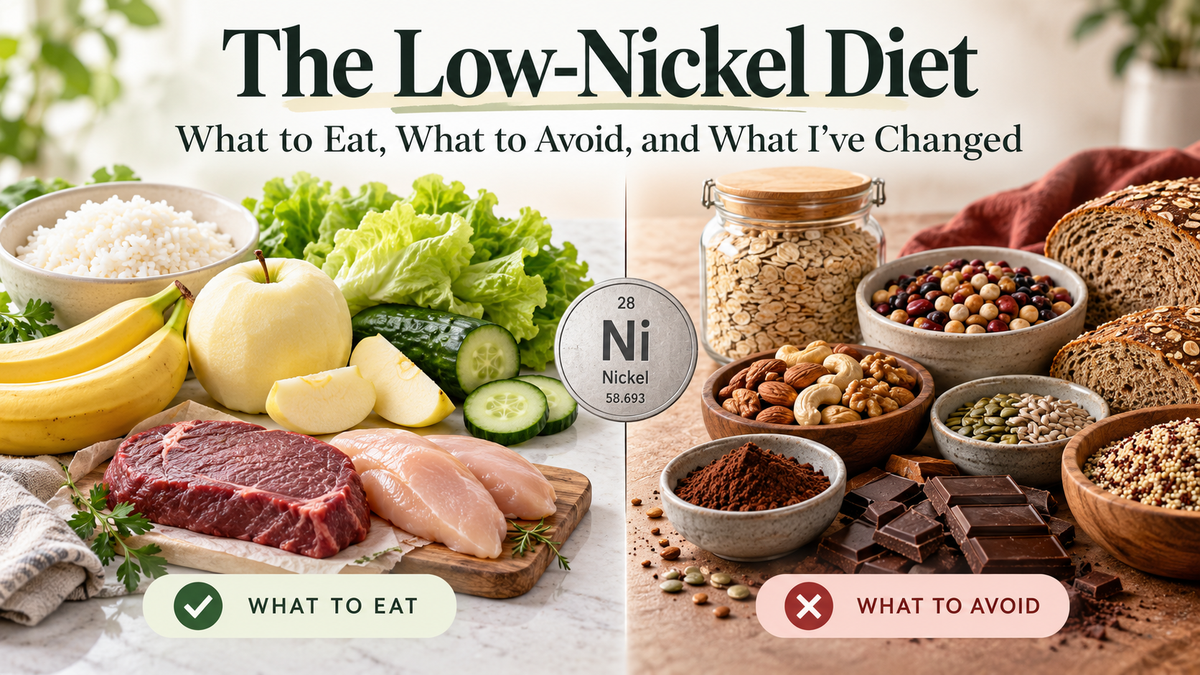
The Low-Nickel Diet LYL Version: What to Eat, What to Avoid, and What I’ve Changed
I need to start this one with a correction.
Not exactly an “I was wrong about everything” correction. Nothing that dramatic. The basic Love Your Liver framework—reduce toxic inputs, support elimination, keep toxic bile moving OUT instead of recycling it forever—has held up extremely well.
But the nickel research forced me to change part of the FOOD strategy.
Quite a bit, actually.
For years, some of the foods I liked for soluble fiber were whole grains, oats, barley, beans, things like that. The reasoning was straightforward: soluble fiber binds things in the gut, helps carry toxic bile out, feeds the right gut microbes, helps with regular bowel movements, etc.
Then I started going down the nickel rabbit hole.
And guess what foods kept showing up?
Whole grains. Oats. Beans. Legumes. Nuts. Seeds.
Oh.
That’s inconvenient.
Then people started taking these foods OUT.
Some people changed almost nothing else. They removed their oats, replaced the calories with lower-nickel starches and fruit, and within days they started getting the same cluster of nickel detox-dumping symptoms that I was experienced when I drastically lowered my nickel exposure.
Skin stuff. Gut stuff. Neurological stuff. Coughing. Sinus stuff.
That got my attention VERY quickly. I am a patterns guy, after all.
The practical approach I ended up with is now substantially different from the earlier Love Your Liver diet. It is currently built around a low-nickel, low-copper, moderate-manganese, low-“vitamin” A diet.
I want to make an important distinction right now:
A “low-nickel diet” from the medical literature and MY current diet are not necessarily the same thing.
That matters.
There isn’t one magical official “low-nickel diet”
This was one of the first annoying things I discovered.
You go into the literature expecting there to be THE low-nickel diet. Nice little authoritative chart. Eat these foods, don’t eat those foods, everybody agrees.

Yeah, nah.
Different researchers have used different cutoffs, different prohibited-food lists, and different ways of estimating exposure. Some remove foods above a particular nickel concentration. Some simply exclude foods consistently regarded as nickel-rich. Some shoot for a total daily nickel intake.
Food nickel itself can vary quite a bit, as I showed in my last article.
So if you’ve looked at five low-nickel lists on the internet and thought, “WHY does one tell me pears are okay while another one tells me they’re forbidden?”

Welcome to the party, pal.
One 2012 human study looked at nickel excretion and several dietary/environmental factors. The authors reported that nickel excretion increased with consumption of nickel-rich foods, among other exposures, and concluded:
“The use of stagnant tap water and consumption of nickel-rich food contribute to the total load.”
Exactly.
It’s a total-load problem, not a magical-food problem.
Influence of dietary factors, age and nickel contact dermatitis on nickel excretion
Another human study is even harder to ignore. Researchers evaluated 86 people who reported intestinal symptoms after eating nickel-containing foods. Among the people with a positive oral nickel mucosa test, 53 went on a low-nickel diet.
After two months:
“52 out of 53 (98.1%) patients showed an improvement of their symptoms.”

BINGO.
When 52 of 53 nickel-reactive patients improve after lowering nickel intake, I am going to pay attention.
Oral mucosa patch test and dietary nickel exposure
There is also a three-month study in 51 people with systemic nickel allergy syndrome, or SNAS, using a low-nickel diet. The authors said the diet was:
“very effective in reducing the clinical symptoms associated with SNAS”
Their diet excluded a surprisingly long list: almonds, beans, cocoa, oats, peanuts, peas, potatoes, spinach, tomatoes, tea, walnuts, various seafoods, several vegetables, and others.
This is not some bizarre concept I invented in my garage.
Low-nickel diet in systemic nickel allergy syndrome

The above video is the newer update where I went back over the earlier diet material, expanded the food list, and clarified how I’m actually approaching this now.
The BIG foods I would remove first
If somebody asked me, “Okay Dr. G, I don’t want to memorize 400 foods. What are the biggest things?”
Good. I’m not gonna memorize 400 foods either.
I want a short list, and I also want CONCEPTS and PRINCIPLES that I can use in nearly any situation
Start here with the AVOID/REDUCE/MINIMIZE list:
Chocolate and cocoa. This includes carob too.
Beans and legumes.
Soy.
Nuts.
Seeds.
Whole grains—especially oats and wheat bran.
Those are the major recurring offenders.
The concept/principle that can be applied here is:
If a plant food is regarded as moderate to high in fiber, it’s almost guaranteed to be relatively high in nickel.
Cacao is particularly ridiculous. In the food material I compiled, general ranges put wholemeal products around 0.1–0.4 mg nickel/kg, beans/seeds/nuts/wheat bran around 1–6 mg/kg, and cacao around 8–12 mg/kg.
Chocolate is NOT a health food.
I know. Somebody is going to be mad.
Chocolate has had one of the greatest marketing campaigns in nutritional history. “Antioxidants!” “Polyphenols!” “Magnesium!”
Meanwhile, hello nickel. Hello copper. Hello cadmium. Hello lead. Hello oxalates. Hello xanthines (includes caffeine). Hello detox-slowing polyphenols/tannins.
But chocolate gets its own halo because somebody measured ORAC values 20 years ago, and the “antioxidant theory of health” failed in every single metric since then.
LOL. No thank you.
Whole grains were the more difficult change for me because those were actually part of what we had been using.
That is one of the biggest changes in my thinking.
I did NOT previously think, “Let’s feed everybody huge amounts of nickel.”
Obviously.
I was looking at the soluble fiber.
Once the nickel issue became apparent, the question became: Can we preserve the benefits we wanted from carbohydrate and soluble fiber WITHOUT bringing along so much nickel?
Yes.
That’s the whole trick.
Refined grains went from “less ideal” to extremely useful
This one is going to short-circuit some nutrition people’s brains.
For decades we’ve all been told:
Whole grain = good.
Refined grain = bad.
End of discussion.
Except nature apparently forgot to read the dietary guidelines.
Nickel tends to be concentrated more heavily in the outer portions of grains. Refining removes much of those outer layers.
Suddenly the “inferior” refined grain can be exactly what we want when we are trying to lower nickel exposure.
My current starch base during the initial phase includes foods such as:
-
White rice
-
Refined wheat products
-
White/degerminated corn and nixtamalized masa
-
Tapioca
-
Pearled barley
-
Refined/light rye
-
Decorticated sorghum or millet
For wheat products, I ALWAYS prefer unfortified whenever possible. I also generally prefer organic where practical, but please do NOT confuse “organic” with “low nickel.” They are completely different questions. Organic agriculture does not magically remove nickel from soil.
White rice is probably the easiest substitution for most people.
White pasta (includes semolina) instead of whole wheat pasta.
White bread instead of whole-grain bread.
Refined tortillas instead of whole-grain wraps.
Masa harina instead of some giant “ancient grain superfood” mixture containing six different seeds, quinoa, flax, chia, oats, and whatever else somebody could stuff into a bag.
I have come to realize and advise that the term “superfood” just means “super concentrated collection of things I don’t want.”
So what am I eating?
This is the part people actually want.
The basic structure is pretty simple.
Muscle meat
The best animal-food choices in the initial phase are:
Red meat: beef, lamb, bison, venison, etc.
Poultry: chicken, turkey, etc.
Animal muscle meat is very useful here, and dare I say necessary, because it allows us to build an adequate protein-and-zinc-containing diet without depending on the very plant foods that are causing the nickel problem.
This is important though—I am not telling everybody to go carnivore.
That’s another place where people can take one idea and run 40 miles past where I said to go.
The problem with an all-muscle-meat diet is that now you’ve removed the soluble fiber and most of the carbohydrate that I still find useful for elimination.
We didn’t discover this nickel issue so everybody could become constipated carnivores.
That’s not the goal.
More on animal foods:
Always avoid organ meats. Don’t eat the animal’s literal organs of detoxification.
We also avoid fish, shellfish, and pork for many good reasons.
Eggs are more of an occasional/backup food for us because I’m looking at more than nickel—egg whites bring sulfur issues for some people, and yolks bring the “vitamin” A issue.
Again: this is where MY approach separates from the generic low-nickel diet.
A published low-nickel protocol may permit eggs or fish because the researchers are asking one question:
How do we lower dietary nickel?
I’m asking more questions (and fixing more problems for people in the process) than that.
Fruits got more important
When whole grains and beans come out, people sometimes panic.
“What am I supposed to eat for carbohydrates?”
Fruit.
This isn’t complicated.
The current list includes:
Apples — peeled is preferable.
Pears.
Green grapes.
Honeydew and lighter-colored melons.
Bananas.
Berries.
Figs, fresh or dried. (see this link for why)
This is also where I don’t want people driving themselves insane with nickel calculators.
If one database says a particular apple has 3 mcg and another sample from another country has 11 mcg, we’re not going to solve that by staring harder at the spreadsheet.
Food nickel varies.
So I concentrate first on the BIG recurring sources.
Oats matter.
Beans matter.
Nuts and seeds matter.
Chocolate REALLY matters.
Getting those giant sources out is much more useful than freaking out because a pear showed up differently in two databases.
Vegetables: this got simpler too
For the stricter initial phase, the vegetables I like best are boring.
That’s okay.
Peeled cucumber.
Light green lettuces.
Then there are foods I would use only occasionally if desired:
Well-peeled zucchini.
Green cabbage.
White onions.
The restrictions here are NOT based on nickel alone. We’re also considering carotenoids, sulfur, “vitamin” A issues, and the other things we’ve already spent years figuring out.
Someone looking only at nickel could build a broader vegetable list.
That’s fine.
They’re doing a low-nickel diet. I’m doing the Love Your Liver approach with nickel incorporated into it.
Different goal.
Dairy is a weird exception
Dairy turned out to be interesting because it tends to be very low in nickel, copper, and manganese.
Those are all useful characteristics for this phase.
The problem?
“Vitamin” A.
So my approach depends heavily on where somebody is in the process.
If you’re brand new to this and already know you’re having major problems with “vitamin” A toxicity, I would skip dairy initially.
If you’ve been doing Love Your Liver for a long time, your tolerance & resilience has improved, and you already know you do okay with dairy, then I consider it an option.
The current diet framework caps dairy roughly around what would supply 500 mg calcium while staying under about 1,000 IU/300 mcg RAE of “vitamin” A per day, with lower being preferable.
As with grain products, we always prefer unfortified and organic. That said, both are not always available, or not available in the same product, so do your best with what you have.
The options I prefer are things like milk, certain yogurts, mozzarella, and cottage cheese, while favoring unfortified, lower-fat, white (not yellow, as in cheddar for example) dairy products when possible.
This flexibility exists because once beans come out, one of the previous calcium sources we previously used disappears too.
My previous video on calcium is below. It came out prior to the nickel toxicity revelations. The info in it is still applicable, while the food choices for calcium have changed:

The diet changed.
So the solutions had to change.
That’s how this SHOULD work.
You learn something new. You change the plan.
You don’t defend an old food list for the next 30 years because you printed it once.
The soluble-fiber problem had to be solved
This may have been the most important practical piece.
If oats, barley in its less-refined forms, beans, legumes, nuts, and seeds disappear, where does the soluble fiber come from?
I did not want to abandon soluble fiber.
I wanted to separate the fiber from the nickel.
The “refined” lower-nickel options I have used and/or would consider using include:
-
Sodium and/or potassium alginates
-
Low-molecular weight modified citrus pectin (as in Pectaclear and Pectasol)
-
Sunfiber / PHGG
-
Apple pectin
-
Glucomannan
-
Acacia gum / gum arabic
-
Beta-glucan products from oats and/or barley that have confirmed low nickel content
That’s a very different strategy from:
“I need soluble fiber, therefore I need three bowls of oatmeal and beans every day.”
No.
I want the fiber.
I don’t necessarily need the nickel-containing package it originally came in.
And this raises another interesting possibility we’ve already seen in people.
Some people believed they were “sensitive to fiber.”
Then they switched from nickel-rich whole-food fiber sources to purified low-nickel soluble fibers—and suddenly the supposed fiber intolerance went away.
Hmm.
Maybe it wasn’t the fiber. Maybe it was the NICKEL that comes with whole-food fiber.
We’ll get much deeper into binders and the mechanics of making nickel elimination tolerable in another article. I’m deliberately NOT turning this into the nickel-detox-supplement encyclopedia.
That monster is coming later.
What about psyllium husk/seed as a soluble fiber?
I’ve received this question multiple times since the low-nickel approach came out.
This is a perfect opportunity to show how our low-nickel food concepts & principles apply in the real world.
We used to like psyllium fiber. We don’t any longer. Psyllium husk/seed fiber is a solid NO on our low-nickel diet.
What does the scientific research say about nickel in psyllium?
-
Significant nickel (and copper!) has been found in psyllium-husk mucilage
-
Psyllium bioaccumulates nickel. The more nickel in the soil, the more nickel in the psyllium.
Now, let’s apply the nickel content concepts & principles to psyllium seed/husk fiber and see if they hold true:
-
Is it a plant food? YES. Is it regarded as high in fiber? YES.
-
Is it a seed? YES. Are seeds generally high-nickel? YES.
-
Is the husk of psyllium seed analogous to the bran of grains? YES. If grains store the majority of their nickel in the bran, then should it be assumed that psyllium seed would store the majority of its nickel in the husk? YES.
The research and our concepts & principles align perfectly. This type of thing is what I do for myself and others in the LYL program, so massive food lists become unnecessary and tedious when we have a solidly principled approach.
The foods I would make NON-negotiable during the initial experiment
For the first three months, if somebody actually wants to learn something from the experiment, I would make these the big removals:
Cocoa and chocolate.
Beans and legumes, including soy, lentils, chickpeas, peas, peanuts.
Nuts and seeds.
Whole grains, including oats, brown rice, whole wheat, quinoa, bran-heavy products.
Organ meats.
For my broader approach, fish, shellfish, and pork are also out during this initial period.
And I would be very cautious about canned foods and canned drinks, which appear repeatedly in low-nickel protocols. Tea and several other beverages also show up on published avoidance lists.
A human study involving women with endometriosis and nickel sensitivity used a high-nickel-food exclusion approach that listed legumes, soy products, oats, whole grains, cocoa/chocolate, sunflower seeds, coffee, tea, canned foods, and several other foods among the things to avoid.
Interestingly, the authors explained:
“its absolute removal from the diet is impossible”
Exactly.
We’re lowering exposure.
We’re not moving to a nickel-free planet.
Nickel sensitivity and effects of a low-nickel diet
Don’t go from oatmeal-and-beans-every-day to super-low-nickel overnight
I need to emphasize this because far too many people ignored the warning the first time. 😎
If your current diet contains:
A lot of oats.
Whole grains.
Beans.
Nuts.
Seeds.
Chocolate.
And you remove ALL of it Monday morning…
You may have an interesting week.
The transition schedule I originally laid out was intentionally simple.
Week 1: cut whole-grain and/or bean intake by about 50%. Replace those calories with lower-nickel starches and fruit. Start arranging your soluble-fiber substitutions.
Week 2: cut the remaining amount roughly in half again.
Week 3: remove the remaining major high-nickel foods and begin the stricter phase.
And if you need to go slower?
GO SLOWER.
There is no Low-Nickel Diet Police coming to your house.
The point is to make progress without making yourself unnecessarily miserable. My original nickel-food notes specifically warned that people moving straight from whole grains, oats/barley, beans, nuts, and seeds into the full low-nickel approach were reporting symptoms within days.
We’ll deal with WHY I think people can temporarily feel worse, what I’ve called “nickel detox-dumping,” in its own article.
It deserves one.
One testimonial that got my attention
One of the more interesting reports came from someone who had been eating low nickel for about two months.
You can hear about it in the video below:

His basic foods were ground beef, chicken, white rice, apples, bananas, and dates.
He reported substantial improvement in chronically dry/irritated skin around the knuckles, scalp itching, and a lower lip that had apparently been chronically chapped for around 20 years.
Then he decided to experiment and had ONE high-nickel meal.
That meal included white beans, barley, and oatmeal.
His hands and scalp hadn’t noticeably changed by the next morning—but the lower lip was chapped and flaky again in less than 24 hours.
That’s a testimonial, aka anecdote.
Not a randomized controlled trial.
This person now knows that nickel is directly connected to their improvements AND where to investigate if this symptom(s) come back.
My food hierarchy now
If I had to reduce this entire article to how I actually think about food during the initial phase now, it would look something like this:
Build meals around muscle meat + a refined low-nickel starch + selected fruit.
Use a few compatible vegetables if you choose (I generally don’t, personally).
Make sure you have an intentional low-nickel soluble-fiber source and figure out the amount you do best on. Realize that this amount will likely change over time.
Use dairy selectively based on where you are in the broader Love Your Liver process.
Get the obvious nickel bombs OUT.
Then stop obsessing over whether one specific food contained 0.7 mcg more nickel than another specific food grown 800 miles away.
We can make ourselves nuts trying to achieve laboratory-perfect nutrition.
Actually, don’t make yourself nuts.
Nuts are high nickel. 😂
Sorry. Had to. 😁

The point is that the diet has become simpler, not more complicated.
The research on nickel looked like it was going to wreck the Love Your Liver food strategy when I first realized how much nickel was hiding in some of the foods we used.
Instead, it refined it.
We still want carbohydrates.
We still want soluble fiber.
We still want bowel movements.
We still want toxic bile leaving the body.
We just don’t need to eat a giant nickel delivery system in order to accomplish those things.
And once I saw that, a bunch of older observations started making a whole lot more sense.
People who “couldn’t tolerate oats.”
People who “couldn’t tolerate beans.”
People who supposedly reacted to “fiber.”
People doing everything else correctly and still dealing with stubborn skin problems.
People who felt dramatically different after removing one or two foods that weren’t supposed to be a problem.
The old explanation wasn’t big enough.
Nickel filled in another piece.
And knowing me, I’m sure the list will continue to evolve as we get more data.
That’s not a weakness.
That’s what you’re SUPPOSED to do when the evidence changes.

Written by Garrett Smith

