Article: MSG & Glutamate PART 3: Surprising Real-World Results for Copper, Zinc, Sleep, Hormones & Food Cravings
MSG & Glutamate PART 3: Surprising Real-World Results for Copper, Zinc, Sleep, Hormones & Food Cravings
What if one of the most demonized food ingredients of the past 50 years could actually help people who have been struggling to improve their health?
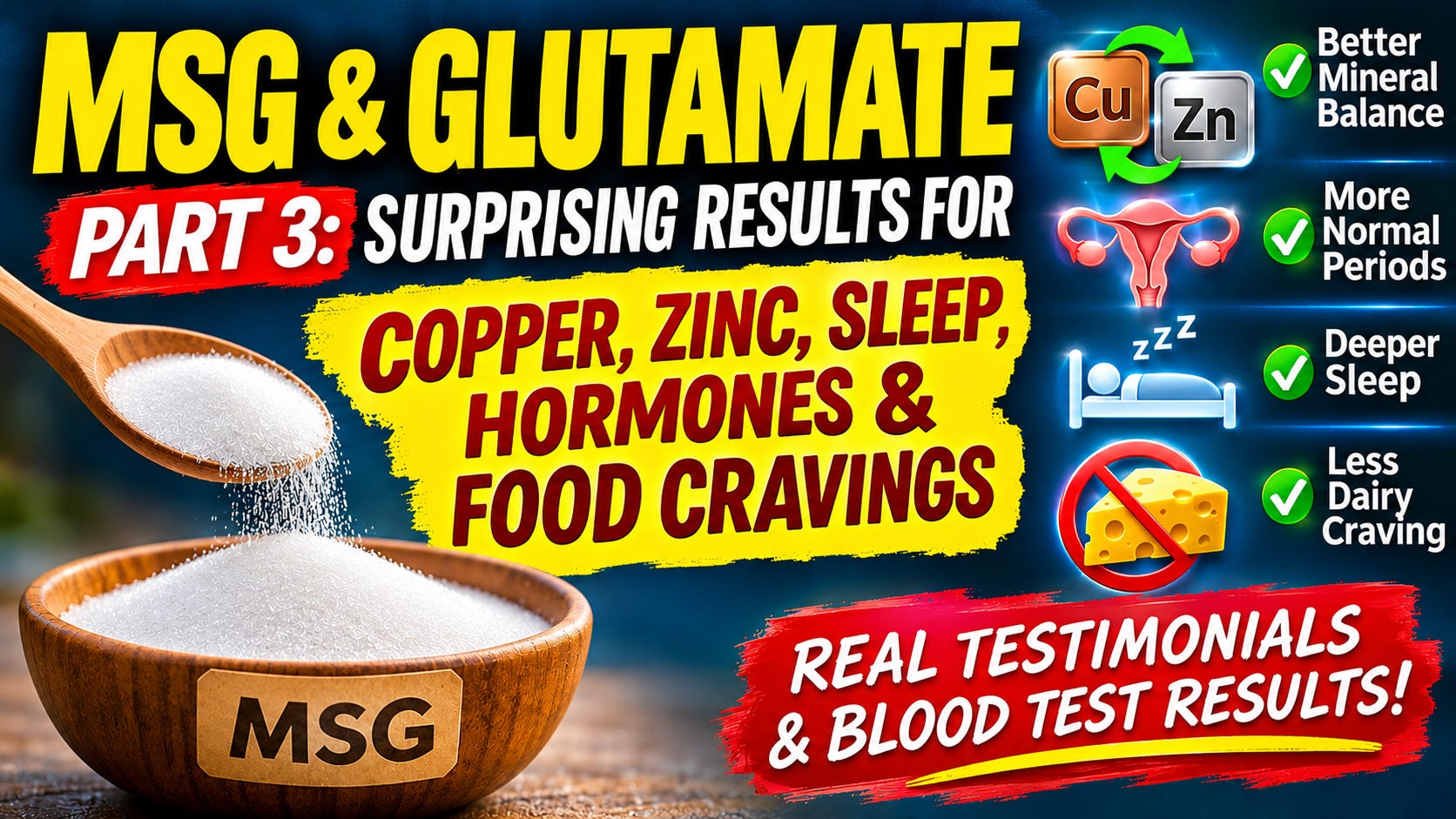
What if someone could improve their zinc-to-copper ratio WITHOUT taking additional zinc?
What if women who had been dealing with prolonged menstrual bleeding suddenly started having more normal periods?
What if people started sleeping better, craving less dairy, tolerating supplements more comfortably, and noticing improvements in their energy and body composition?
I’m talking about MSG.
Yes, monosodium glutamate.
The stuff that people have been told causes brain damage, headaches, obesity, and just about everything else.
In Part 1 of this series, we investigated the research behind MSG’s terrible reputation.
In Part 2, we explored glutamate’s roles in ammonia detoxification, energy production, nutrient absorption, liver metabolism, and cellular protection.
Now we’re getting into what happened when people actually started experimenting with it.
Because the experiences Kelsey and I began hearing were pretty remarkable.
Some involved improvements people could FEEL.
Others involved actual changes in laboratory measurements.
Several caught me completely by surprise.
Some of the most interesting reports came from people who had been working on their health for years.
Let’s get into it.
How Kelsey Discovered MSG’s Potential for Copper and Zinc
Kelsey is our main health consultant/facilitator.
She’s an amazing researcher who has contributed tremendously to our investigation of glutamate.
Kelsey had already made substantial progress with her health through dietary changes, flush niacin, and other parts of the Love Your Liver approach.
Her serum copper, which had originally measured approximately 140, had come down to around 110–112.
That’s significant progress.
She was also experiencing improvements in several other areas.
Yet she wanted to improve her zinc-to-copper ratio further.
There was one main obstacle though.
She didn’t particularly enjoy taking supplemental zinc.
Increasing her zinc sometimes left her unusually tired.
Sometimes taking too much would make her so tired she needed multiple naps in a day.
That made it difficult to use as much zinc as she wanted.
Rather than just accepting that situation, Kelsey decided to see whether there might be another way to improve mineral metabolism.
She researched organic acids, amino acids, and various compounds that might interact with copper.
That investigation eventually led her to glutamate.
The Research Kept Leading Back to Glutamate
Interestingly, Kelsey first encountered MSG while looking into nutrients that might support hair growth and cellular energy.
She initially set the idea aside.
Like most people, she’d heard the scary claims about MSG.
Later, while continuing her research into copper metabolism, she revisited glutamate.
This time, she investigated more deeply.
She found connections involving amino acid metabolism, mineral chemistry, liver function, and the body’s handling of unwanted substances.
Eventually, she decided MSG deserved a closer look.
That’s where things got interesting.
An Unexpected Change in Her Menstrual Cycle
Kelsey had occasionally experienced prolonged menstrual bleeding.
She suspected this might be related to her copper-to-zinc imbalance.
She had already investigated vitamin K and other approaches.
After revisiting her glutamate research, she decided to experiment with MSG.
Her first attempt was rather aggressive.
She took approximately 4 grams in total, divided between water and food.
What happened?
She reported that her menstrual bleeding stopped the following afternoon.
That’s certainly an interesting observation.
She also developed painful neck stiffness that lasted approximately two days.
She interpreted that reaction as possibly related to changes in detoxification.
Kelsey subsequently favored a more conservative approach to the amount of MSG she used.
Yet the change in her menstrual bleeding was significant enough to make her want to investigate further.
Improvements Beyond Her Original Goal
Kelsey also reported improvements in several other areas.
Her energy improved.
Her mood improved.
She noticed better concentration and task initiation.
She felt more sociable.
She also reported favorable changes in body composition and better zinc supplement tolerance.
Remember, her original interest was mineral metabolism.
She wasn’t looking for a sleep supplement, a mood supplement, or a bodybuilding supplement.
She was investigating copper and zinc, yet began noticing improvements in other areas of her health.
That is what made the experience particularly interesting.
Then we started hearing from other people we shared the .
And some of those reports were even more surprising.
Watch the Original MSG Presentation — LYLL #212
Kelsey and I presented the original research, discussed how this investigation began, the initial experiences involving MSG, and the biochemical connections that made us interested in the subject.

Wardee’s Experience: From Nearly Eight Weeks of Bleeding to More Normal Periods
One of the first people Kelsey and I contacted about trying out MSG was Wardee of Traditional Cooking School.
She had been dealing with prolonged and heavy menstrual bleeding.
Sometimes the bleeding would begin to slow down, only to start again.
She called this rebleeding.
One episode lasted nearly EIGHT WEEKS.
She had developed anemia and needed iron supplementation.
Wardee had found that only MK-7 (a form of vitamin K2) helped manage the bleeding.
Yet she was having to taking substantial amounts (up to 5 pills) several times daily.
When she learned about Kelsey’s experience with MSG, she was very interested in trying it.
What Happened After She Introduced MSG?
Wardee started with small amounts.
She experimented until she found an amount that agreed with her.
Then she began noticing changes.
She reported that her bleeding would stop after using MSG.
By the second day, she had stopped taking the high-dose MK-7 she’d previously relied on.
Think about that.
She had gone from taking approximately five vitamin K2 pills daily to taking NONE in the space of two days.
According to the testimonial she provided approximately three and a half months later, she hadn’t needed to resume them.
She also reported that she no longer needed supplemental iron.
That’s a pretty dramatic change from someone who had previously experienced bleeding lasting nearly two months straight!
Her Periods Became Shorter and Easier
Wardee described substantial improvements in her menstrual cycles.
Previously, her periods might last seven to fourteen days or longer.
After introducing MSG, she reported periods lasting approximately five to six days.
She also described:
-
Less menstrual bleeding
-
Much milder PMS
-
Fewer headaches
-
Less fatigue
-
Better sleep
-
Less menstrual-related weight gain
-
More predictable cycles
She said that some months her PMS symptoms were so mild that she had difficulty knowing her period was coming.
For a woman around 50 years old who had experienced significant menstrual problems, that was quite a change.
Her Energy and Physical Activity Improved, Too
Wardee also described having much more energy.
She increased her walking.
She was able to work out with weights more often.
She reported better tolerance of niacin, soluble fiber, sunlight, and even beef.
That last one caught my attention.
Wardee had previously struggled to tolerate the zinc content of red meat.
She associated eating too much beef with unpleasant copper-related reactions.
After introducing MSG, she reported being able to tolerate more beef.
That’s particularly relevant to our investigation of MSG improving zinc tolerance.
She also reported that her nighttime leg cramps stopped and that she was sleeping much better.
She even noticed improvements in symptoms she associated with electromagnetic sensitivity.
Now here’s the part I want you to pay attention to.
Wardee was using approximately ¼ teaspoon of MSG per day.
That’s it.
Not several tablespoons.
Not some complicated supplement protocol.
A quarter teaspoon.
She described the difference as tremendous.
Why Wardee’s Experience Got My Attention
There were several changes happening at once.
Her menstrual bleeding improved.
Her vitamin K requirements changed.
Her iron supplementation changed.
Her zinc tolerance appeared to improve.
She had more energy.
She slept better.
And she became more physically active.
That’s a considerable range of observations.
The critical and mostly unknown relationship between glutamate and vitamin K-dependent clotting proteins was one of the reasons we became interested in the bleeding reports.
Vitamin K is involved in modifying specific glutamate residues within proteins that help blood clot normally.
The biochemical relationship is established, and these experiences raised additional questions about whether glutamate metabolism might be relevant to the problems these women had experienced.
Then another woman shared a very different bleeding-related experience.
Megan: A Longstanding Throat-Bleeding Problem Improved
Megan, from Eat Beautiful, described a problem she’d experienced for years.
After previously using serrapeptase, she began experiencing recurring bleeding in the back of her throat.
It would sometimes occur when she brushed her teeth.
The problem continued intermittently.
She tried vitamin K.
Higher amounts helped somewhat, but the bleeding persisted.
After Wardee introduced her to our MSG research, Megan decided to experiment.
Two Changes She Noticed Almost Immediately
Megan reported two particularly significant improvements.
First, her recurring throat bleeding stopped.
Second, she noticed a substantial improvement in energy and mood.
She specifically described it as cheerful energy.
That’s an interesting description.
She wasn’t talking about feeling wired or overstimulated.
She was talking about feeling happier and more energetic.
Megan eventually found that she preferred larger amounts of MSG than some of the other people we’d spoken with.
She described using approximately two to three teaspoons on certain days.
She also continued taking vitamin K.
Her experience illustrates something we noticed repeatedly.
People were experimenting with different amounts and reporting different responses.
Some noticed substantial changes with very small quantities.
Others used more.
Megan’s Family Reported Changes, Too
Megan also shared MSG with her adult daughter and teenage son.
Both reportedly noticed improvements in mood.
She described them as more cheerful, optimistic, and positive.
Her daughter also reported improvements in menstrual symptoms.
She’d previously experienced substantial cramping and bleeding.
During her first month using MSG, she reported less cramping and considerably less menstrual blood loss.
Interestingly, her daughter was using only small amounts sprinkled onto food.
So now we had reports from several women describing improvements in bleeding or menstrual symptoms.
Kelsey.
Wardee.
Megan.
Megan’s daughter.
Different circumstances.
Different amounts.
Yet several reported changes in the same general area.
That pattern certainly caught our attention.
MSG and Better Zinc Tolerance: One of the Most Interesting Benefits
Let’s return to zinc.
Because this may be one of the most important observations for people following my work.
Some people have difficulty tolerating supplemental zinc.
They may experience fatigue or other symptoms when trying to increase their intake.
Kelsey had encountered that problem.
Wardee had experienced difficulty tolerating even the zinc in certain foods.
Then we started hearing reports of improved zinc tolerance after introducing MSG.
One Member Could Finally Take Keystone Minerals Daily
One member described having difficulty taking Keystone Minerals consistently.
After experimenting with MSG, they reported eventually being able to take Keystone Minerals every day without noticeable side effects.
That’s significant.
Because if someone is trying to improve their zinc status, difficulty tolerating supplementation can become an obstacle.
Finding ways to improve tolerance makes the process considerably easier.
I Reduced My Own Keystone Minerals Intake by HALF
Here’s something I noticed myself.
For a considerable period, I’d been taking two servings of Keystone Minerals based on my laboratory testing.
After experimenting with MSG and reviewing subsequent blood tests, I found that I could reduce my Keystone Minerals from two servings to one while maintaining the results I wanted.
I CUT MY MINERAL SUPPLEMENTATION IN HALF.
Think about that.
I SELL supplements.
And here I am telling you about something that might help people need LESS supplementation.
What kind of supplement salesman does that?
One who’s interested in helping people get better rather than keeping them dependent on ever-increasing supplement doses.
If someone can maintain favorable laboratory measurements while taking less supplemental material, that’s an outcome I’m interested in.
And that brings us to one of the most interesting laboratory reports.
His Zinc-to-Copper Ratio FLIPPED Without Taking Supplemental Zinc
During our follow-up livestream, we discussed a member who reported a remarkable change in his blood tests.
Previously, his serum copper was higher than his plasma zinc.
That’s a relationship I pay close attention to.
One of the goals in my approach is to improve the zinc-to-copper relationship.
The member introduced MSG.
He wasn’t taking supplemental zinc.
Yet on subsequent blood testing, he reported that his plasma zinc was finally HIGHER than his serum copper.
THE RELATIONSHIP HAD REVERSED.
WITHOUT adding zinc.
Read that again.
He wasn’t simply taking more zinc to drive up his plasma zinc measurement.
He reported an improvement in the relationship between zinc and copper after introducing MSG.
Now THAT gets my attention.
Because it raises some important questions.
Did zinc absorption improve?
Did the body’s utilization or distribution of zinc change?
Was copper being handled differently?
Were multiple processes involved?
Those are the kinds of questions Kelsey and I have been investigating.
Copper and Zinc Can Interact Differently With Glutamate
Kelsey also investigated some interesting chemistry involving glutamate and metals.
Glutamate can interact with minerals such as copper and zinc.
Different metal-glutamate compounds can have different chemical properties, including solubility.
She was particularly interested in evidence concerning differences between copper-glutamate and zinc-glutamate compounds.
My interest is whether those chemical differences might help us understand some of the changes people have reported.
Especially when combined with glutamate’s roles in liver function, nutrient metabolism, and cellular energy.
The observations raise a question I’ve been interested in for years:
What if improving mineral status sometimes requires improving the way the body HANDLES minerals, rather than simply adding more of them?
That’s a much bigger issue than just how many milligrams of zinc someone takes.
Better Sleep: Another Unexpected Pattern
Here’s something that should surprise people who’ve heard MSG described as a dangerous excitotoxin.
We kept hearing about BETTER SLEEP.
Not worse sleep.
Not people feeling wired all night.
Better sleep.
Some described deeper sleep.
Others reported fewer nighttime awakenings.
Several said they were waking feeling more rested.
Let me help with the definition of “excitatory” and “inhibitory”, as it is used in the word “excitotoxin”.
Excitatory = “accelerating”, also turning something ON.
Inhibitory = “braking”, also turning something OFF.
If you want to drive (aka exist), you have to use BOTH at certain times.
We’ve been brainwashed into the simplistic and wrong excitatory = BAD.
Glutamate is the most ABUNDANT neurotransmitter in the human body.
Hard to justify it as a “toxin” without serious mental gymnastics.
Let’s do better.
Heather Reported Better Sleep and Less Heartburn
Heather reported that MSG relieved her heartburn.
She also described much deeper sleep.
Other people reported improvements in sleep after introducing MSG into their routines.
One participant who frequently woke around 3 a.m. described sleeping until approximately 5 or 6 a.m. more often.
Another reported better sleep alongside the disappearance of nighttime leg cramps.
Wardee also described major improvements in sleep and less insomnia associated with PMS.
Now think about that.
For someone who regularly wakes in the middle of the night, sleeping more continuously can make a substantial difference in everyday life.
Why Might People Sleep Better?
We discussed some of glutamate’s biochemical roles in the previous articles.
One relevant connection is that glutamate is the precursor for GABA, the body’s major inhibitory neurotransmitter.
Glutamate is also involved in energy metabolism and nitrogen handling.
I’m interested in whether changes in these systems might help explain some of the sleep improvements people described.
Here’s the funny part.
People have spent decades being warned that MSG is an “excitotoxin”.
Meanwhile, some people are adding it to their food and reporting calmer moods and deeper sleep.
That’s certainly not what the typical MSG scare story would lead you to expect.
Food Cravings: Could People Actually Be Seeking Glutamate?
Now let’s talk about something that could be particularly useful for people following a low-”vitamin” A and/or low-nickel diet.
FOOD CRAVINGS.
I’ve spent years discussing the problems associated with dairy.
Yet some people find it extremely difficult to give up cheese.
They know they’re trying to reduce their dietary “vitamin” A exposure.
They understand why they’re avoiding certain foods.
Yet the cravings continue.
Why?
Kelsey became interested in whether glutamate might be part of the explanation.
Aged cheese can contain substantial amounts of free glutamate.
Tomatoes contain glutamate.
Meat contains glutamate.
Wheat contains glutamate
Fermented foods can contain substantial amounts.
Glutamate produces the savory taste known as umami.
Let’s review.
Cheese, tomatoes, beef, and wheat together are basically American restaurant foods in a nutshell.
Americans have been psy-opped into avoiding MSG more than almost any other group.
Some people report that they get cravings and even symptoms that ONLY seem to be relieved by eating “unhealthy” restaurant foods.
Are Americans purposely seeking out the high levels of glutamate in these foods?
A Human Study Found MSG Reduced Cravings for Savory Foods
A 2018 randomized controlled trial was titled Prolonged Exposure to Monosodium Glutamate in Healthy Young Adults Decreases Perceived Umami Taste and Diminishes Appetite for Savory Foods.
The researchers studied 58 healthy adults.
Participants consumed vegetable broth daily for four weeks.
One group received broth containing 3.8 grams of MSG.
The control group received sodium-matched broth without MSG.
What happened?
The MSG group reported reduced desire for savory foods.
They also consumed less savory food during the experimental meal.
The researchers concluded:
“attenuates perceived umami taste and appetite for savory foods”
Read that again.
MORE MSG exposure was associated with LESS desire for savory foods.
That’s rather different from the usual claims that MSG inevitably drives people to overeat.
And it fits with another testimonial we received.
Mike Reported Less Desire for Dairy
Mike, from PricePlow, began experimenting with MSG after Kelsey and I introduced him to our research.
Mike had already been following a low-”vitamin” A approach.
He examined the studies himself and became interested in MSG’s potential benefits.
He started adding MSG to his food.
One method he described involved mixing MSG with salt in a ratio of approximately one part MSG to six parts salt.
He found that it made protein-containing foods more satisfying.
Then he noticed something unexpected.
His household was craving LESS DAIRY.
He also reported improvements in body composition, mood, and overall satisfaction with meals.
That’s particularly interesting because dairy had been one of the foods he was trying to avoid.
Could MSG Make It Easier to Give Up Cheese?
This is one of the practical possibilities that caught my attention.
If some people crave cheese partly because of its glutamate content or savory flavor, perhaps providing glutamate through another food seasoning could reduce that craving.
The human trial provides an interesting piece of evidence.
Repeated MSG exposure reduced the desire for savory foods.
Mike reported less desire for dairy after using MSG regularly.
Kelsey had been investigating similar questions about cravings.
What if some food cravings could be reduced by providing the particular component the person is seeking?
That could make certain dietary changes considerably easier.
Especially for people trying to avoid high-”vitamin” A, high-nickel, and high-copper foods.
MSG, Mood, Focus, and Mental Energy
Another recurring category of reports involved mood and mental performance.
Kelsey reported improvements in concentration and task initiation.
She also noticed positive changes in sociability.
Megan described more cheerful energy.
Her adult daughter and teenage son reportedly experienced improvements in mood.
Mike reported feeling more satisfied and generally better after meals.
Several people described feeling calmer while also having more energy.
That’s an interesting combination.
They weren’t describing stimulation.
They were describing feeling more functional and more positive.
Body Composition: Another Unexpected Change
Here’s something I noticed in my own body.
My weight increased somewhat.
Yet I wasn’t seeing the increase in body fat I’d normally expect.
My legs appeared leaner.
I seemed to be carrying more muscle.
I had not suddenly drastically increased my training volume.
Kelsey also reported favorable changes in body composition.
Mike described similar observations.
Now consider what we’ve already reviewed about glutamate.
It can contribute to cellular energy production.
It participates in amino acid metabolism.
Human studies have demonstrated that skeletal muscle can take up glutamate.
MSG can influence the circulating availability of several amino acids after a meal.
Those findings make the body-composition observations particularly interesting.
Better Energy Often Means More Activity
Wardee described walking more and lifting weights more frequently.
Others reported feeling more capable of exercising or carrying out ordinary daily activities.
If someone’s sleep improves and their energy increases, they may naturally become more active.
That can influence body composition over time.
I’m interested in the relationship between these different changes.
Not simply whether someone reports a temporary energy boost, but whether their overall physical functioning is improving.
Other Unexpected Reports: Heartburn, Vision, and Eye Fatigue
Some of the experiences we heard were particularly unusual.
Heather reported that MSG relieved her heartburn.
Another person described improvements in eye fatigue.
They had previously switched between multiple pairs of glasses throughout the day.
Sometimes three pairs.
Later two.
After introducing MSG, they reported being able to use the same pair all day without switching.
They also described less eye fatigue.
That’s a rather unusual observation.
And it illustrates how varied the reports have been.
People weren’t all noticing the same thing.
Yet several were reporting improvements in areas where they’d previously struggled.
These reports helped broaden the questions we were asking about glutamate and metabolism.
How People Were Actually Using MSG
Now let’s discuss the practical side.
Because one of the biggest mistakes people make when learning about something potentially useful is assuming that MORE must automatically be better.
I’ve seen that mentality create problems with all kinds of supplements.
Someone finds something interesting.
They immediately take an enormous amount.
They feel terrible.
Then they conclude the substance itself must be bad.
The amount matters.
The person’s overall situation matters.
What they’re consuming with matters.
MSG Is a SEASONING
One of the main points Kelsey and I discussed was using MSG with FOOD.
That’s its ordinary purpose.
It doesn’t require some complicated supplement routine.
MSG is inexpensive.
It’s widely available.
And it can be added directly to meals.
We discussed products such as Ajinomoto MSG, which is commonly sold in Asian grocery stores and online.
For someone using small amounts as a seasoning, a package can last quite a while.
We’re talking about something that costs only a few dollars.
Not some expensive proprietary supplement blend.
We Were Particularly Interested in Protein-Containing Meals
Kelsey and I discussed using MSG with meals containing protein.
Why?
Because glutamate naturally occurs in protein-containing foods.
The human research we reviewed in Part 2 found that adding MSG to a meal could increased circulating concentrations of several amino acids that would have been in the protein foods.
People Reported Benefits From Very Different Amounts
Some people used only a sprinkle.
Others used approximately ¼ teaspoon daily.
Some experimented with larger quantities.
Wardee reported substantial benefits using approximately ¼ teaspoon.
Megan described using considerably more.
Kelsey initially experimented with approximately 4 grams and experienced an unpleasant reaction alongside the improvement she was looking for.
The most striking observation is that several people reported noticeable changes from relatively small amounts used with food.
MSG Doesn’t Make a Poor Diet Healthy
Here’s something else I’ve emphasized.
Adding MSG to junk food doesn’t magically make that food healthy.
If someone is consuming large amounts of substances they’re trying to avoid, MSG doesn’t erase those exposures.
The overall diet still matters.
If you’re trying to reduce dietary nickel, copper, toxic “vitamin” A, or other substances that may be contributing to your problems, that remains important.
You can’t simply sprinkle something useful onto a food that is causing problems and assume everything is fixed.
That should be obvious.
Yet apparently, it needs to be said.
Don’t Just Assume Something Is Working
I appreciate testimonials.
They’re often what gets us interested in researching something.
Yet I particularly like testimonials that come with laboratory measurements.
Kelsey’s serum copper improved substantially during her broader health program.
One member reported a reversal in the relationship between plasma zinc and serum copper after introducing MSG.
I reduced my Keystone Minerals intake while maintaining the laboratory results I wanted.
Those are the kinds of observations that interest me.
Because if someone feels better, I want to understand what else is happening physiologically.
TEST, DON’T GUESS, THEN ADDRESS.
That principle hasn’t changed.
And it’s just as relevant to our MSG investigation as it is to everything else I do.
Watch the MSG Follow-Up — LYLL #214
After the first presentation, more people began asking questions and sharing their experiences. In the follow-up livestream, I discussed additional observations involving MSG, ferritin, nutrient metabolism, food cravings, and other issues.
The Bottom Line: Multiple Remarkable Experiences With an Inexpensive Food Ingredient
Let’s review what happened.
Kelsey was investigating ways to improve mineral metabolism and zinc tolerance.
Her research led her to glutamate.
She experimented with MSG.
And she began reporting improvements in areas she hadn’t necessarily expected.
Then other people started trying it.
Wardee reported major improvements in menstrual bleeding, PMS, energy, sleep, and nutrient tolerance.
Megan described improvements in a longstanding bleeding problem and mood.
Her family members reported their own changes.
Mike reported less dairy craving, better food satisfaction, and improvements in mood and body composition.
Other members described better sleep, improved zinc tolerance, and changes in their blood tests.
One member reported that his zinc-to-copper relationship reversed without adding supplemental zinc.
I was able to reduce my own Keystone Minerals intake by half while maintaining the laboratory results I wanted.
That’s a considerable range of experiences.
It’s particularly interesting when you consider what we’ve learned across this three-part series.
Glutamate is a naturally occurring amino acid.
Your body manufactures it.
Your intestines use it.
Your liver uses it.
Your muscles use it.
It’s involved in energy production, nitrogen metabolism, glutathione, digestion, and multiple other important functions.
Human research has demonstrated that MSG can affect circulating amino acid concentrations after a meal, certain aspects of digestion, and appetite for savory foods.
That’s a very different picture from the one people have been given about MSG for decades.
I’ve spent years investigating nutritional toxicities and the problems they can create.
One thing I’ve learned is that improving someone’s health isn’t always as simple as adding more supplements.
Sometimes the issue involves how the body handles what it’s already receiving.
Sometimes a relatively simple dietary change raises questions that lead to important research.
That’s exactly what happened here.
I think glutamate metabolism may be an overlooked part of the puzzle involving copper, zinc, energy, and nutrient utilization.
The research gives us several reasons to investigate those relationships.
The personal experiences give us additional observations worth examining.
And the laboratory results make the entire subject even more interesting.
What If MSG Wasn’t the Enemy We’ve Been Told It Was?
For decades, people have been taught to fear MSG.
Yet the human body has been making, using, transporting, and recycling glutamate all along.
And now we’re hearing from people who are reporting improvements after adding MSG to their food.
Not just one person.
Multiple people.
With different symptoms, different backgrounds, and different experiences.
That’s what made this investigation so interesting.
I also want to give Kelsey credit for the curiosity, persistence, and research that helped get this entire project started.
She was trying to better understand mineral metabolism.
She kept asking questions.
She followed the biochemical evidence.
And she brought us into an area of research that has produced some fascinating findings.
Sometimes that’s how discoveries begin.
Someone notices a connection that everybody else has overlooked.
They investigate it.
Suddenly, a familiar subject starts looking VERY different.
What if one of the most demonized food ingredients of the past 50 years has been hiding extremely useful benefits in plain sight?
Here’s to MSG…bringing better health and tastier food, all at the same time!

Written by Garrett Smith