

Where Is All This Nickel Coming From? The Exposure(s) NO ONE Can Completely Avoid
When I first started going down the nickel rabbit hole, I was mostly thinking about food.
Oats. Beans. Nuts. Seeds. Chocolate. The usual “high-nickel diet” stuff.
Then you start looking at water.
Then stainless steel.
Then jewelry.
Then dental work.
Then cigarette smoke.
Then agricultural soil.
Then fertilizers.
Then sewage sludge.
Then air pollution.
Then welding.
Then medical implants.
At some point you have to stop and ask:
Wait...where is all this nickel NOT coming from?
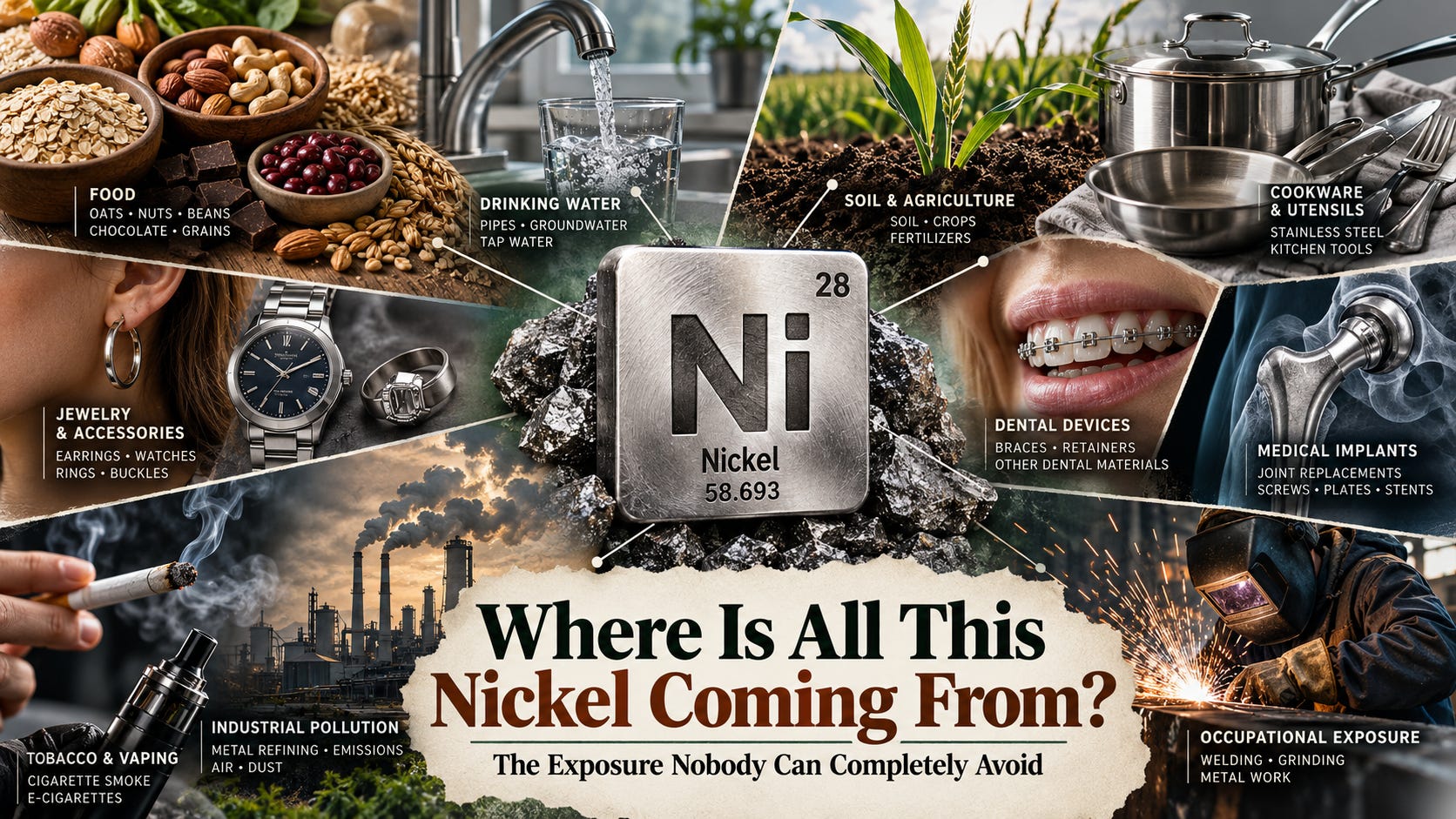
That was the point where my thinking about nickel changed quite a bit.
Nickel isn’t an obscure exposure that only matters if somebody works in a nickel refinery. It is one of those exposures where the individual sources can look small when you examine them one at a time, while the total exposure picture looks very different.
My larger nickel research report described nickel as being found in stainless steel, jewelry, cookware, medical and dental implants, electronics, tobacco smoke, industrial emissions, food, and drinking water.
That’s quite a list.
And it still isn’t the whole list.
The National Cancer Institute is unusually straightforward about this. Their nickel page says:
“The general population is exposed to low levels of nickel in air, water, food, and tobacco smoke.”
They go on to mention coins, jewelry, stainless-steel cookware and eating utensils, while occupational exposures include mining, smelting, welding, casting, and grinding.
Air.
Water.
Food.
Smoke.
Stuff touching your skin.
Stuff you cook in.
Your job.
Yeah.
So much for this being some rare exotic exposure.

The above video is where I first laid out the much larger nickel problem instead of treating nickel as merely a skin-allergy issue.
Food was only the beginning
Food probably deserves to be where most people START thinking about nickel because diet is a repeated exposure. Day after day. Meal after meal.
But I’m deliberately not going to turn this into the nickel food article, because that article is coming and there is WAY too much to put here.
The broad pattern is enough for now.
Our nickel food work keeps bringing us back to several categories: cocoa/chocolate, soy, legumes, nuts, seeds, oats, wheat bran, and whole grains.
The 2020 EFSA nickel assessment also found substantial dietary exposure across European populations, and whole grains were especially important because people eat so much of them.
That distinction matters.
A food doesn’t have to be the #1 highest nickel food on Earth to become a major exposure.
You just have to eat enough of it.
Every. Single. Day.
This is one of the mistakes people make when looking at food charts. They obsess about whether Food A has 20% more nickel than Food B while ignoring the fact that they eat Food B three times a day.
Additive. Accumulative. Dose-dependent. These are all critical terms to understand here.
There’s another problem too: nickel in food is not necessarily fixed.
Plants get nickel from their environment.
Which means eventually you wind up looking at the soil.
And THAT rabbit hole got weird.
Soil, fertilizers...and agriculture adding nickel on purpose
Nickel exists naturally in soils. Nobody disputes that.
Some geological areas contain far more nickel than others, and different plants vary enormously in their ability to take it up.
Okay.
But modern agriculture is not operating on untouched prehistoric soil.
We add things.
Fertilizers.
Pesticides.
Industrial contaminants.
Waste products.
Sewage sludge.
And, in some circumstances, nickel itself.
I found research using foliar nickel on wheat in an effort to alleviate glyphosate-related problems. The researchers reported:
“Both shoot and grain Ni concentrations were enhanced by foliar Ni treatment.”
Foliar nickel application alleviates detrimental effects of glyphosate drift on wheat
Read that again.
They put nickel on the plant.
Nickel in the grain went up.
This isn’t my interpretation. That’s the experiment.
Nickel is a plant micronutrient because plants use a nickel-containing urease enzyme. Fine.
Humans are not plants.
The fact that an agricultural crop may benefit from nickel does not automatically mean I want more nickel showing up in my food.
Then I got into biosolids.
Our earlier research turned up the U.S. sewage-sludge rules that specifically allow cumulative nickel loading onto agricultural land.
Well...of course that became another rabbit hole.
Because once nickel is added to soil, you’re no longer just discussing “soil nickel.”
You’re discussing the entire chain:
soil → plant → animal or human → waste → environment → soil again
You could say it’s a really crappy cycle, and you’d be right. 😉
That’s the kind of thing I mean when I say you can’t understand nickel by looking at one exposure source in isolation.
I’m going to do a much deeper article on nickel in agriculture because otherwise this article will turn into a book.
Water may matter WAY more than the raw number suggests
This was one of the findings that really got my attention.
A classic human experiment gave volunteers nickel either in drinking water or together with food.
The researchers reported:
“Absorbed nickel averaged 27 +/- 17% ... in water vs 0.7 +/- 0.4% ... in food”
Nickel absorption and kinetics in human volunteers
That’s nearly a 40-fold difference under those experimental conditions.
Now, the water dose was taken after fasting, so don’t go turning this into “all nickel in water is always absorbed 40 times more.”
That’s not what they proved.
But COME ON.
Our water research also turned up another problem: sometimes the nickel is coming from the WATER SOURCE...and sometimes the plumbing adds it afterward.
Nickel has been measured coming from plumbing fittings, stainless-steel pipework, certain well components, chromium-plated fixtures, and nickel-containing heating elements (as in electric kettles). In some documented situations, standing water had much higher nickel after prolonged contact with metal plumbing.
So your municipal water report is useful.
It is not necessarily the same thing as testing the water coming out of your kitchen faucet.
We are going to get MUCH deeper into this one separately.

This episode is the natural deep-dive companion to the food, water, fertilizer, biosolids, and regulatory exposure issues introduced here.
Then stainless steel started showing up everywhere
This subject is ridiculous once you notice it.
Most people hear “stainless steel” and mentally translate that into:
Safe inert metal that doesn’t do anything.
That’s not actually what “stainless” means.
Most stainless steel contains nickel.
Our food research notes that stainless-steel pots and utensils can contribute nickel to food, with heat, acidity, salinity (salt), and time of cooking increasing the release of nickel into the food (aka “leaching”).
That immediately gives you a bunch of obvious questions.
What happens when you simmer tomato sauce?
Cook with vinegar?
Use lemon?
Store acidic foods?
Boil acidic water?
What stainless grade is the equipment?
How old is it?
Is the surface damaged?
How long is the food in contact with it?
I started looking into this, and very quickly realized stainless steel needed its OWN article.
Because stainless steel isn’t just pots.
It is utensils.
Water bottles.
Commercial food-processing equipment.
Brewing tanks.
Pipes.
Faucets.
Tools.
Medical devices.
Dental hardware.
Kitchen appliances.
Probably something within arm’s reach of you right now.
I’m not saying to run around your house screaming and throw everything metallic in the trash.
That isn’t useful.
I AM saying that “stainless steel” should be generally assumed to be exposing you to nickel until the type of stainless steel is confirmed otherwise.
Those are not the same statement.
I’ll be going over the different types of nickel-containing (or non-nickel) metal options in regards to cookware, silverware, and jewelry in a future video & article.
Jewelry is obvious...until you realize how much contact exposure there is
Nickel allergy from jewelry is so well established that even conventional medicine doesn’t argue about this one.
Earrings are probably the classic example.
But jewelry is only one part of the contact-exposure issue.
Our nickel risk document includes:
-
earrings and piercings
-
necklaces and other jewelry
-
watches
-
belt buckles
-
buttons and zippers
-
phones and laptops
-
metalworking tools
-
braces and retainers
-
surgical implants
Girls getting their first earrings very young, along with generally increased jewelry and piercing exposures, is a huge part of why nickel sensitization and nickel toxicity is demonstrably worse in women.
Think about earrings for a second.
You intentionally punch a hole through the skin.
Then you put metal in the puncture wound.
And leave it there.
For years.
If that metal releases nickel, this isn’t the same thing as briefly touching a nickel-containing doorknob.
The wedding ring I wore for 20 years, 24/7/365, was half white gold and contained nickel.
Frequency matters.
Duration matters.
Moisture matters.
Sweat matters.
Friction matters.
This is also where I think the language around “nickel allergy” can make people stop thinking too soon.
Contact dermatitis is real.
Nickel allergy is real.
That said, observing an inflammatory skin reaction does not magically prove that the skin is the only tissue that ever matters.
That’s an interpretation people seem to have made without asking the larger exposure question.
Then I started thinking about the metal IN people
This was when the subject got much more personal for me.
I had braces for 3.5 years.
Then a retainer for another 3.5 years.
Then a permanent retainer on my bottom teeth for 15 years.
Once I started researching orthodontics, I found papers saying nickel may make up a very substantial percentage of orthodontic alloys.
One study on orthodontic retention wires stated:
“Ni is an important component of orthodontic appliances (8-50 wt%).”
50% by weight of a known neurotoxic metal like nickel being put long-term into people’s mouths is crazy, right!?!?
And then:
“All investigated wires release considerable amounts of Ni”
The researchers tested the effects of mechanical loading and pH, and acidity increased nickel release.
So if you’re trying to reconstruct someone’s lifetime nickel exposure, years of nickel-containing metal sitting in their saliva and being sublingually absorbed and swallowed deserves a critical spot on the list.
I’m going to go as far as saying that if someone had braces, they’re GUARANTEED nickel toxic.
Another study measured nickel in plaque and saliva of orthodontic patients and concluded:
“nickel release occurs into the dental plaque and components of saliva”
Nickel in dental plaque and saliva in patients with and without orthodontic appliances
Well, there you go.
Orthodontics are only part of it.
Crowns can contain nickel.
Dental alloys can contain nickel.
Some medical and surgical hardware contains nickel.
Stainless-steel implants can contain nickel.
Nitinol is literally nickel-titanium.
There’s so much here that I’m intentionally stopping.
Dental work and implants are getting their own article.
What about the air?
You don’t only eat nickel.
You breathe it.
Remote rural air contains nickel.
Cities contain nickel.
Industrial areas can contain much more.
Combustion contributes.
Metal processing contributes.
Industrial emissions contribute.
Dust contributes.
Occupational exposure can dwarf ordinary ambient exposure.
Our air research summarized typical concentrations as roughly 1–3 ng/m³ in remote areas and 5–35 ng/m³ in rural and urban air, while cigarette smoke adds another very important inhaled source.
The National Cancer Institute lists mining, smelting, welding, casting, and grinding among occupations involving nickel exposure and says workers are exposed mainly through nickel-containing dust and fumes or skin contact.
This is one place where the scientific literature is NOT subtle.
Occupational nickel exposure is a known problem.
Nickel compounds are established occupational carcinogens.
The debate isn’t whether nickel exposure can matter.
We already know it can.
The much more interesting question to me is what we should make of decades of lower-level exposure from many different sources in the general population.
I don’t think that question has been adequately put together until now.
Tobacco gets nickel from somewhere too
Tobacco turned into another one of those “oh, of course” moments.
Plants pull metals from soil.
Tobacco is quite good at accumulating some of them.
A paper on cigarette smoking and nickel exposure says:
“The tobacco plant contains nickel and several other toxic metals”
and discusses soil, fertilizers, and pesticides as possible sources.
Cigarette smoking and nickel exposure
So now connect that back to the agriculture section.
Nickel in soil doesn’t necessarily stay in soil.
Then there are e-cigarettes, where the plant isn’t even required.
The device itself contains metal.
A recent study investigated corrosion of heating coils and nickel leaching into e-liquid and aerosol, and in the animal inhalation portion they reported significant nickel accumulation, particularly in the liver.
Heating Coil Corrosion by E-Liquid Containing Nicotine Lactate Salt
So the nickel question around smoking/vaping isn’t simply:
“Does tobacco contain nickel?”
You may have plant-derived nickel.
Combustion exposure.
Metal heating elements.
Industrial contamination.
Different devices.
Different formulations.
Different exposure chemistry.
We’ll handle smoke and air in their own article because—once again—this gets big FAST.
I’m also going to suggest you disregard and ignore entirely a particular puffy-faced chiropractor telling you that nicotine is the savior to all human diseases.

Industrial nickel does not politely stay inside the factory
This was another framing problem I started noticing.
We talk about occupational exposure as though there’s a force field around the industrial site.
Worker goes inside: nickel exposure.
Worker walks outside: nickel exposure problem over.
Except industrial nickel ends up in air.
And waste.
And soil.
And water.
And sediments.
And landfills.
And sewage.
And eventually plants.
The modern ATSDR toxicological profile reports nickel at hundreds of hazardous-waste sites and notes that much of the nickel released from reporting facilities goes into soil.
It also states:
“Nickel typically accumulates at the surface of soils”
and can concentrate in plant species.
ATSDR Toxicological Profile for Nickel
See how we just looped back to agriculture AGAIN?
That’s why I stopped viewing these as separate subjects.
They’re separate research categories.
They’re not separate in the real world.
Air deposition becomes soil.
Soil becomes plants.
Plants become food.
Industrial waste enters water.
Water runs through metal plumbing.
Food goes into stainless-steel processing equipment.
Humans eat it, drink it, inhale it, wear it, work around it, and sometimes have nickel-containing alloys permanently implanted in them.
That is the actual exposure picture.
Not:
“Did you eat chocolate today?”
Chocolate does absolutely matter, way more than people realize.
But that question is WAY too small.
The total-exposure idea changed how I think about this
People tend to look for THE source.
I don’t think that is how nickel is going to work for many people.
Maybe somebody has eaten a high-nickel plant-heavy diet for 30 years.
Somebody else wore nickel-releasing jewelry constantly.
Somebody had braces, followed by a permanent retainer.
Somebody welds stainless steel.
Somebody smokes.
Somebody drinks well water with nickel.
Someone else has multiple smaller sources stacked together.
And many people probably have several of these at the same time.
That’s why I think of this as a nickel exposure stack:
-
Food.
-
Water.
-
Cookware.
-
Plumbing.
-
Jewelry.
-
Dental work.
-
Smoke.
-
Air.
-
Job.
-
Industrial/environmental contamination.
None of the individual exposures has to be dramatic for the total to become interesting.
That’s also why I don’t think trying to eliminate every last atom of nickel from your environment is either realistic or necessary.
You can’t.
Nickel exists naturally.
It is used heavily by modern industry.
It is already distributed throughout the environment.
So the useful question isn’t:
“How do I achieve zero nickel exposure?”
You won’t. If you try it, you may create more issues than you solve.
The useful questions are more like:
Where are my biggest exposures?
Which ones are repeated every day?
Which ones are easy to change?
Which ones have been present for decades?
Which exposures involve eating or drinking nickel?
Which involve inhalation?
Which involve metal sitting directly against tissue?
THAT gives us somewhere useful to go.

This later episode revisits the exposure picture after months more digging and explains why cookware, silverware, plumbing, food, and other “hidden” sources needed their own deeper treatment.
And I’m not going to cram all those deeper dives into this article.
We have dedicated articles coming on nickel in food, the low-nickel diet, drinking water, air, stainless steel, cookware, jewelry, dental work, implants, and the other major exposure categories.
Because now we have the map.
Nickel isn’t coming from one place.
That’s the problem.
It’s coming from enough places that most people have probably never added them together.

Written by Garrett Smith


